Trucks on Trial – Renault C440 vs DAF XF430 vs Scania 420G
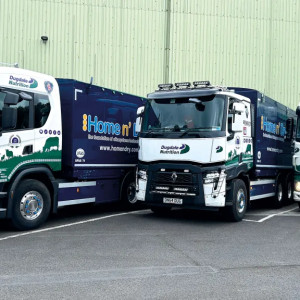
Once Tridems were a novelty, now, less so as more operators want maximum weight on a rigid are finding they offer the payload of a conventional 8×4 twin steer and the manoeuvrability of a six-wheeler. Tridems are eight-wheelers capable of a 32-tonne GVW, but they have three rear axles and one front axle instead of two front and rear axles. The rear axle will steer and usually lift as well.
There are two setups: an 8×4 double drive ahead of that rear axle or an 8×2 with the drive axle in the middle. One sector where Tridems are hugely popular is animal feed haulage, where trucks have to travel long distances to rural delivery points and are then greeted with restricted access when they get there. Most of these farms are decades, even centuries, old when a 32-tonne eight-wheel lorry was simply not seen.
Some of them started farming before lorries were a thing! Payload is important – if a lorry can make two, three or even four drops in a day without returning to base, its productivity is improved. In the north of England – Lancashire, Yorkshire, Cumbria, Northumberland and Durham- farms are commonplace but spread far apart.
There’s lots of mileage involved in delivering animal feeds. The terrain is also challenging. There are many country roads where speed is hard to gain.
It’s stop-start, hilly, and demanding. You need a decent engine with lots of power and torque. On the plus side, trucks typically only carry a load on their outward journey, and even then, that load steadily diminishes throughout the day as deliveries are made.
The rise in popularity of the Tridem chassis means all seven major manufacturers now offer them straight from the factory, with Volvo and DAF particularly successful in this sector. So while a conventional 8×4 will still be a bigger seller – especially for the tipper men, for rigids with animal feed, curtainsider, even beavertail bodies, the Tridem makes a lot of sense, the former as an 8×4, the latter two often as an 8×2. Often, you find animal feed producers run their own fleet of trucks.
The product – and its delivery – is vital for their customers, so relying on a third party to deliver – pardon the pun – precisely what they say they will, and when, is a headache, these companies can ill-afford to chance. With their own fleet, they can deliver exactly to their customers’ needs as and when needed. A well-run, own-account fleet can also save the company money.
Dugdale Nutrition is based in Clitheroe, Lancashire, and has been serving farms in Northern England for 175 years. It is a family-owned firm. Dan Brown, the company’s transport manager, talks about the company and its operations.
Says Dan: “Our main base is in the town, but we also have another site at Speke in Liverpool, which we bought in 2017 and is used to manufacture and distribute animal feed. The second site, which has three trucks, was bought to expand the business. But we’ve always been in Clitheroe.”
The site is impressive and also noticeably immaculately presented. Despite animal feed being one of those things ‘that can get anywhere’, the yard is pristine. The company also owns Home and Dry and now RBC Agri, which both cater to different animal feeds and grass seeds. “The animal feed is mostly taken across the North West, Lancashire, North and East Yorkshire, North Wales, Derbyshire, Cumbria and the Scottish borders – anywhere we can get to and back within a drivers day.
Most of the shifts are day work, but that said, we do cover the whole of the UK with the Home and Dry product, from Cornwall to Scotland. Some drivers stop out; the DAF driver, for example, is out all week.” With that in mind, the trucks must have decent sleeper cabs. “Some drivers do nights out.
We try to do two loads a day if possible. There are five drops tops per lorry load.” The fleet is a mix of rigids and artics, with 13 of each.
Across the 26-strong fleet is a mix of Scania, Volvo, DAF, and Renault. It has previously had MANs and ERFs in the fleet. The rigids are seven Scanias – one 6×2, one 8×4 standard eight-wheeler, and five 8×4 Tridems.
Most are G410 models, with a 2024 model being the new 420G Super. They are joined by three Renault C440 Tridems, one DAF XF430 Space Cab Tridem, one Volvo FM420 Tridem – the new cab shape, one FM420 – 6×4 ‘bag wagon’ – with the old cab and one Volvo 6×2 FM380 bulk blower also with the old cab. An old 56-plate Volvo FE280 6×2 rigid curtainsider is also retained for internal shunting.
The tractors are six Scanias and seven DAFs. For the former, there is one old cab G450, three New Gen R450s and two newer 460R Supers. Another 460R is on order.
Other DAFs are all New Generation XF480s or XF530s with high-roof sleepers. Most are 6×2 tag axles, although there are also a couple of small midlift examples. “We are moving towards DAF as we like the new range,” says Dan. The XF430 Tridem, as featured in this piece, has the older cab as when it was ordered, a new generation XD model in that axle set-up wasn’t available, and with an XF high roof cab would have been too high for the mill as was, surprisingly, a high roof Space Cab CF.
Now, the XD is available as a Tridem, while it is also possible to order a flat roof sleeper XF as a Tridem. That also explains why the Renaults were ordered with the flat roof sleeper cab – the higher roof wouldn’t have fitted in the mill. “The Scania G cab is an ideal height,” says Dan. It has the common standard-height sleeper cab, but were it necessary, a lower flat roof Scania G cab was an option.
A high-roof sleeper most definitely wasn’t! The day cab Scania G on the 6×2 rigid also has a standard-height roof, giving the driver better headroom. There are two tautliners for bagged animal feeds – one is a Muldoon tandem rear steer, and the other is an SDC tri-axle with tri-deck rear steering.
Both the taught liners can carry a Moffett on the back to aid with off-loading at some of the farms. The rest of the fleet are either blowers or tippers. Dugdale is a very progressive company that accepts internships and apprentices.
It is keen on hiring new, young blood. Five of its drivers are due to retire over the coming years, and it is keen to recruit new, younger recruits to fill the void. It is also looking at a 175th anniversary lorry for next year, which Dan says “should be a 460R Scania tridem with standard sleeper and a few extras!”

Operator’s verdict
“We typically go for 420-450hp for the rigid Tridems.
I’m a firm believer in bigger engines for better fuel returns, despite the slight weight penalty,” which explains why the XF is a – relatively – rare 430hp version – the lowest output of the MX13 12.9-litre straight six. The Renaults and Scanias deliver about 9-9.6mpg, but the DAF is much poorer typically 7-8mpg. Dan says the new DAF XFs are doing much better on fuel, so it’s not a major concern. “Sadly, the new cab was not an option when we ordered the DAF during the pandemic.”
“The Renaults have replaced three Volvos. When I was gathering quotes, I didn’t even get a price from Volvo. I admit I’ve not had the best experience from our local Volvo dealer.
So, replacing Volvos with Renault was all due to the after-care service we got from the dealer. “Lynch Trucks is the best service provider we have currently. It is an authorised DAF service and repairer agent based in Altham.
It is excellent and part of the reason we have switched to DAF. The actual price was also a factor. The driver loves his new DAF.
My stepdad also drives for us, and he was a Scania man through and through, but he loves his DAF. “We did have some delays in getting new vehicles during the pandemic, which is part of why we started to look at Renault, as we could get a chassis from them quicker than anyone else. Scania was saying 18 months.
The supply is much better now, however, the latest Scania was ordered in July and was delivered in November, the DAF was even better – ordered in June and with us in September. Scania also held the price, while the DAF even came down in price a little bit.” Dan says the fleet isn’t likely to increase too much in the forthcoming years, “unless other business opportunities come up which may change this”, he says.
“We tend to keep the trucks for five years or 600,000kms, whichever is reached soonest. We seem to find that at 600,000km, the reliability will most likely become troublesome, and the preventative maintenance bills go up.” There are 38 drivers on the books.
18 work four days on, four days off, a set-up that many drivers like these days. The remaining 20 are Monday to Friday drivers and relief/casual drivers. ” Some of the trucks are out seven days a week, which has understandably led to an increase in mileage. He says there have been no issues with the Scanias as a rule, “and we’ve had the brand longer.
The 17-plate old P series, which has 800,000km on it, has just replaced liners and seals. It’s used as a spare truck.” “Our fleet used to be day cabs, but we’ve progressively moved to sleeper cabs.
A 64-plate Scania P410 bought in 2014 was the first to have a sleeper. I drove that!” he says. “But we’ve phased out day cabs as the comfort of a sleeper is a massive plus point. In addition to delivering animal feed, the trucks collect the raw materials needed to make the different types of feed.
Two trucks are dedicated to collecting raw materials from the docks. Animal feed sales are typically contracted, and the company delivers to keep the farms replenished. Out of the three trucks under scrutiny in this piece, the DAF and Renault have Muldoon bodies and blowing gear, with the Scania having Priden equivalent.
Across the fleet, Muldoon is now the preferred bodybuilder. “Everything was once Priden, and some of the older trucks still have Priden, but most of the new kit has Muldoon. We have a good relationship with the sales team there, plus the price is also a factor.” The bulkers are all fitted with blowers, augers, and a barrel for feeding feed into the tubes, and they have several associated pipes.
“We don’t reuse the bodies, but we could do in the future, although I am concerned over who would just buy a Tridem chassis cab with no body.” Price is an important but only one of the factors when buying a new truck after-sales service, and looking after your drivers is equally important. The old shape DAF was the cheapest at the time, but it also offered the driver who was allocated one of the best cabs to stay away from home in; the new generation DAF model is priced further towards the Scania and Volvo end of the scale.
The Renault was roughly 8% more than the DAF, and the Scania nearly 10% more than both. The Scania’s Priden body was also some 20% more than the Muldoon bodies. While the Scania will fetch more on the aftermarket, the differential will be lucky if it matches the higher initial cost of some GBP27,000 over the Renault.
Also, the DAF and Renault have a year longer on the R&M package, which is worth roughly another GBP10,000. Interestingly, the current prices are a little more closely matched. The Scania is still the most expensive, but the Renault is the cheapest.
However, they are also some 20% more than what Dugdale’s has previously been paying. The trucks are bought outright on a hire purchase agreement; only one tractor unit remains on a contract hire arrangement, which may be purchased and added to the fleet permanently. “We had bought the occasional second-hand vehicle when we needed an additional truck, but as a rule, we always buy new, especially in the rigids.
We have bought a couple of second-hand tractor units from Smiths Brothers.”

DAF XF430 FAW
Model: DAF XF430
Design GCW: 32,000kg
Chassis: 3,900mm wheelbase
Front axle: 9,000kg capacity.
Rear axles: 13,000kg (drive) 8,000kg (rear steer)
Gearbox: TraXon 12-speed automated manual
Engine: MX13-315 12.9-litre 6-cylinder in line, Euro 6e
Max power: 428bhp @ 1,600rpm
Max torque: 2,300Nm @ 900-1,125rpm
Cab: Space Cab High roof sleeper The DAF is a bespoke vehicle tailored to the operator’s specialist needs. It has a big engine but is not overly powerful, a cab that fits, and, of course, the Tridem chassis.
It weighs just over 14 tonnes with its body, so payloads of around 17.5 to 18 tonnes are regularly achieved. Says Dan: “We bought this truck to the spec we needed but also for the driver – the Space Cab gives him extra living space. But I also bought one because I wanted to try a DAF.
“DAF had previously only offered an 8×2 Tridem but has recently moved on to offer the 8×4 variant we need. We prefer double drive for its superior traction. The roads we cover and the weather conditions we experience mean a double drive will get us out of most sticky situations.”
If Dan had a criticism of the DAF, it would be the aerodynamics; “the cab is a ‘bit of a brick’,” he laughs. “The visibility out of the windscreen is also not as good as the new DAFs.” The XF430, however, has impressed Dan enough to have a new XF Tridem priced up. That would have the flat roof sleeper – “The new XF high roof might be too tall for the work the truck will do, but I don’t want an XD as that only has the MX11 engine, although that does look smart! “The trucks all look smart, I like to have a good road presence.
Plus, there is plenty of power! I’ve had no issues with the DAF whatsoever.” The truck was bought through Lancashire DAF, and Lynch is looking after it, undertaking its six-weekly examinations and all the other work that needs to be done.
It was also purchased with three years’ R&M. “The dealers look after us, as does the local garage. We have two-weekly safety checks for greasing, general maintenance, wear and tear, and tyres. “The DAF was very much bought with the driver in mind, and we talked to him about the vehicle.
The new DAF models have very much improved the marque’s products.”

Scania 420G
Model: Scania 420G
Design GCW: 32,000kg
Chassis: 3,750mm wheelbase
Front axle: 9,000kg capacity.
Rear axles: 8.500kg (drive) 7,000kg (rear steer)
Gearbox: 12-speed manual automated
Engine: DC13 174 12.74-litre 6-cylinder in line, Euro 6e
Max power: 420bhp @ 1,800rpm
Max torque: 2,300Nm @ 900-1,280rpm
Cab: standard roof sleeper The Scania 420G is a compact truck with the newer Super 12.7-litre engine, which still seems new but was launched over three years ago. It’s fair to say the Super engines have been delivering the increased fuel consumption that Scania promised.
The Dugdale 420Gs deliver about 9-9.4mpg, which is much better than the DAF. The unladen weight is just over 14 tonnes, meaning a 17.5 to 18-tonne payload can be achieved. Dan says one of the best features of the Scania is that “It’s a Scania!
And that means it has good driver appeal.” He adds that he doesn’t like the look of the heavier-duty XT chassis, and “Image and vision are a big part of the thought process.” He says the price is still a concern but adds: “They do sell easily when the time comes. That said, I’ve never had a problem selling any Tridem chassis.
Owner drivers tend to buy them, and the residuals are typically GBP50,000-70,000.” Preston Scania looks after Dugdale’s Scanias, and Dan says, “It looks after us; it’s very good. We also use Scania agent SJ Bargh at Lancaster as a maintenance provider–it has the parts, as it also uses rear steers on its milk tankers. “We took two years of R&M on the new Scanias, as that is all Scania will offer us.
We can extend the service plan, but that makes it more expensive. “The Scania probably has the best build quality, though the DAF is well built. As regards the Renault, only time will tell as it’s too early to say.”

Renault C440
Model: Renault C440
Design GCW: 32,000kg
Chassis: 3,900mm wheelbase
Front axle: 9,000kg capacity.
Rear axles: 9,750kg (drive) 7,500kg (rear steer)
Gearbox: Optidriver ATO 2612F 12-speed with automatic clutch
Engine: DE13 12.8-litre 6-cylinder in line, Euro 6e
Max power: 440bhp @ 1,700 rpm
Max torque: 2,200Nm @ 925-1,400rpm
Cab: Flat roof sleeper
As mentioned, Dugdale has fallen into Renault rather than actively looking to buy them, but debatable support from Volvo and long lead times for other manufacturers’ chassis have led Dan to the door of a Renault dealer. And so far the results have been promising enough for him to order a third truck after the first two have proved satisfactory. The C440 delivers 9.6mpg, the best of the trio, and also successfully accommodates a 17.5 to 18-tonne payload.
When asked about the good features of the French truck, there is a noticeable pause before Dan answers. “They have good kerb appeal. And we’ve made them look ok! It does turn heads.
“It has also surprised the chap who drives it, loves it. He says it has comfort and power. It has a 12.8-litre engine.
The driver used to have a Volvo FM410 with a 10.8-litre engine. He’s an ex-owner driver and says it’s the best truck he’s ever driven.” Dan adds that “price was another good factor, not to mention the availability of the exact chassis I wanted.
We could get Renaults when we couldn’t get anything else.” On a roll, he adds: “We have a good relationship with Diamond Trucks in Warrington, and it linked well with Muldoon.” The Renaults are serviced through JDS at Blackburn, “and it is very good,” says Dan, adding: “We have a good relationship with Matt Keys at Diamond Trucks. The backup so far has been very good.”
There’s not a lot Dan doesn’t like about the Renaults, other than the need to have a flat roof does limit the storage in the cab for the driver; “there are no cupboards, although it does have a fridge,” have adds.
Drivers’ verdicts
David Walmsley: Renault C440 A local from Clitheroe, David Walmsley, is 60 years old and in charge of the Renault. He has been a driver for 39 years, the last eight of which have been with Dugdale.
He’s a big fan of his big French truck, having moved up from a 68-plate Volvo FM. He highly praises the C440: “I love it, and I rate it a lot. It’s a fantastic truck with everything you’d want.”
He added that he’d come out of a Volvo FM Globetrotter. “This is superior, but that said, the new Volvo FM might be as good as this is now! But this is a lot better; I’m delighted with it. It’s a really good wagon.
I’d rather have a Renault than a Scania.” David doesn’t do nights out, and while initially saying the FM had more storage than the flat roof Renault as it had a high roof, that’s not an issue: “I don’t need a lot of space for the day work I do. The storage is good enough for a day driver.”
David doesn’t share the lorry with another driver as he works five days a week, Monday to Friday, although others occasionally use it at weekends. “It pulls fantastically, and it’s always on top of the job having the 13-litre engine.” He also praises the comfort of Range C. “The FM had a horrible seat, but this is right comfy. It always gives a good driving position and will push back further.”
But as he doesn’t do nights out, he can’t offer too much opinion of the bunk: “I’ve never even been on it!,” he laughs. “But I imagine it’s comfier than the Volvo as it’s got a mattress topper, which my Volvo didn’t have!” All the buttons and switches are well placed “once you get used to it,” he adds. So, is there anything he doesn’t like about it? “Not a lot. The only bugbear is the sun visor, which annoys me.
It comes down by pressing a button, but there’s a gap in the corner, so some sun always gets into your eyes.” In conclusion, he’s happy with the truck, which he says is superior to anything else he’s driven on the fleet, although he does add, “The build quality might be better on the Scanias.” Les McCormick: Scania 420G
In charge of the Scania is 64-year-old Les McCormick, who originally hails from Liverpool but has lived in Clitheroe for the last 40 years. A driver with 30 years’ experience under his belt, he’s on his second stint with Dugdale, which has been for the last seven years. He’s previously worked for Fagan & Whalley and Crown Paints
“It’s a superb motor,” he says of his Scania. “It’s superb both in vision and manoeuvrability. It pulls up any hill, even when fully loaded. On farms, it’s fantastic.
I used to have an 8×4, which had the turning circle of a barge, but being able to lift or steer the rear axle is so helpful in tight situations.” This is not his first Scania: “I have driven many other trucks in the fleet, apart from the Renaults.” Les does four on, four off, so he shares the truck with Frankie Thornber, and neither do nights out even though the truck has a sleeper cab. “The sleeper means there’s plenty of room, which I like.
The controls are well placed. I do drive on the cruise control almost constantly, and the buttons for that [on the steering wheel] are superb.” The truck’s storage is great: “There are big cupboards under and above the bunk.
It’s also got a fridge, which is good.” Les is only 5ft 4 1/2 in tall while Frankie is 6ft, so the fact the steering wheel and seats have multiple positions is a big boost, so sharing the truck is not an issue! “It’s only a two-minute job to get the seat and wheel right for me. The windscreen is much lower compared with the older models, which is much better.”
He rates the driving experience of the 420G but has one minor gripe: “When on the cruise control on the motorway, it picks up on the hills, but before the crest of the hill, it knocks off, and you lose speed. But besides that, there’s nothing to fault the truck on.” John Slinger: DAF XF430
Despite being 68, John is one of the few trampers in the Dugdale fleet and has the DAF XF with its bigger cab for 18 months now. He’s from Ingleton in the Yorkshire Dales and has held his HGV licence for more than 30 years and has worked for various firms but has been with Dugdale for over ten years now. “It’s a nice truck, the fourth DAF I’ve had.
It could pull a bit better. I’d prefer the 11-litre 450 or the 480 with the MX13.” But he likes the cab despite it being the old XF shell. “The cab is fine for stopping out in.
The Super Space cab would be too high to get under bins, and the top of the cab and the body are level in height. But this is fine.” The storage is “fine for me,” he says.
He’s also happy with the driving position and layout of the buttons and controls: “Everything is fine.” John says the bunk is “Comfortable enough and gives a good night’s sleep.” He leaves Clitheroe on Monday, tends to operate out of Speke for the rest of the week, and returns home on Friday. “It looks like a big truck, but its turning lock is better than on a Volvo Tridem.
It’s a pretty handy truck.” There’s not much he’d change on the truck: “I did like the Volvo FM Globetrotter that I had before but this has more room. I’m used to the three-step entry now!”
Pip Dunn’s verdict
Initially, I assumed the DAF was an XF450 or an XF480, so I was quite surprised that it was an XF430 – a rare model, especially as a FAW Tridem. I was also intrigued why the old cab had been specified, but the interview with Dan explained everything.
Dugdale is proud of its fleet, but it is also pragmatic and sensible in its vehicle choice. It’s not brand loyal and it is always looking out not only for the exact vehicle to do the job but also a good deal, and good back up Except the DAF, these are not trampers’ lorries, so the biggest cab is not needed – which is just as well, as they don’t fit in the mill!
Payload is important, as is fuel economy and dealer support. Having spoken to Dan and the drivers and seen the vehicles firsthand, Renault is the clear winner of this ToT. It’s a good-spec vehicle that looks superb, is the best on fuel, matches the payload, and represents the best cost of ownership.
The DAF is let down by its poor fuel returns and dated cab, although a new XF430 or XF480 with a flat roof sleeper – or, even better, if it will fit in the mill, a high roof sleeper – would address both those deficiencies. That said, the XF Space Cab is a decent place for the driver to work and sleep. The Scania has a lovely cab, and there’s not a lot to fault it on, as it is proving to be a good all-rounder.
However, a higher cost and a reduced R&M offering mean that financially, it isn’t as strong as Renault. Of course, if the Swedish truck’s durability outlasts that of its French or Dutch counterparts, that could be an important ‘bigger picture’ factor in future purchases. However, based purely on the black-and-white facts and stats presented by the operator, Renault comfortably scoops the Truck on Trial win in this instance.
This Aryicle first appeared in the February 2025 issue of TRUCKING.
To buy single copies or to subscribe visit the KELSEY shop: https://shop.kelsey.co.uk/subscribe/trucking-magazine