Road Test: Volvo FH500 Aero
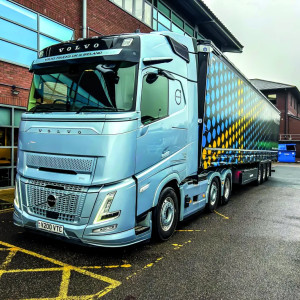
For several reasons, it’s taken me a while to get behind the wheel of a new Volvo Aero and put it through its paces, but that’s by-the-by now as I have at last done just that. And here’s my verdict on what is potentially going to become one of the most common sights on the UK’s roads. Some will, perhaps, call this a Version 6 FH, but that’s not true.
Volvo has given it its own bespoke moniker – Aero – so it should be easy for those who want to slap stickers onto their trucks to clearly identify what they are driving! It should also be stressed that the V5 FH, with the digital dash introduced in 2020, remains fully in production, and the Aero is essentially the same truck with some extra aerodynamic aids. The Aero also sees Volvo finally join the digital ‘mirrors’ club.
You can also specify these on an FH V5 without the Aero front end, and also, if you really don’t like them, you can have an Aero fitted with conventional mirrors. You can also get Volvo’s digital mirrors – which it calls the Camera Monitoring System (CMS) – on an FM and FMX (but not an FL or FE). Interestingly, a taste of what was to come with the Aero was seen way back in the summer of 2016 at the Elmia show in Sweden, complete with the smooth front end and digital mirrors.
At its launch proper in January 2024, the Aero was certainly striking. Typically, the keyboard warriors were out with their, mostly derisory, comments – it seems change is never applauded. I have to admit, the Aero reminds me a little bit of the iconic InterCity 125 train of the mid-1970s.
Yes, it looked a bit different, even a bit strange, but every new truck does. And, and apologies if I sound like a broken record here, the truth is, you can only truly judge its looks when you see them painted in a customer liveries. Whereas DAF exploited the new measurements allowed by the EU in truck cab design on its XG with a completely new cabin drawn up from scratch, the FH Aero still uses what is essentially the same cab shell as launched with the FH Version 4 in 2012.
As we know, the life of a new cab is now typically 20 years-plus (MAN’s TGX is now 25 years old), so in that respect, the FH was still only half-life. The Aero package is basically a bolt-on to the front of the V5 cab that improves aerodynamic efficiency and saves fuel, which in turn helps reduce emissions. Volvo used the new legislation to devise the XXL cab, which gives drivers more length and a wider bunk to put it in the same ballpark as the XG.
So, if the looks of the Aero really ‘offend’ you, you can still buy a V5 FH cab without any. Personally, having seen plenty of FH Aeros now in all manner of colours, it does look the business. It sort of looks a little ‘sad’ – especially in plain white, but painted nicely they look amazing.
Also, you don’t have to have the Globetrotter high roof cab option on an Aero. But looks are not important – well, for a lorry, they shouldn’t be, but an ‘attractive’ truck looks good for your business, and if you ask me, the Aero does that very well indeed. But the new look is there, as I say, to save fuel, which in turn saves you money and reduces your emissions.
Technical overview
The FH500 has been neck and neck with the FH460 as Volvo’s best seller. A 6×2, long-haul tractor in the Aero and Globetrotter forms with the Turbo Compound engine and a mid-lift axle, it is the perfect tool for Volvo’s marketing and sales teams to offer as a crossover from a fleet motor to a prestige truck. It will appeal to those seeking either option.
The truck has a 4,100mm wheelbase with a midlift pusher axle. The power comes from the D13K 500 Euro 6 Turbo Compound 12.8-litre six cylinder engine and that gives an incredibly impressive torque output of 2,800Nm. The transmission is Volvo’s AT2612 I-Shift 12-speed automated gearbox, which is well established and very popular with drivers.
Being a press truck, the vehicle I was driving had a host of extras, and the driver of this example would benefit from air suspension front and rear, wireless remote suspension control and dynamic steering. The axle capacities are what you’d expect – front was 8,000kg, the drive axle was 11,500kg and the midlift 7,500kg. The RSS1344F rear axle had a very sensible ratio of 2.31:1, and the front and mid lift axles were shod with 385/55 R22.5 tyres, while the drive axle had 315/70 R22.5, all from the Michelin X Line Energy range.
Wheels were Alcoa Durabrites. The chassis was the understandable medium height. Inside the Globetrotter Aero extended front cab with CMS (Camera Monitoring System) was the Driving Plus (Drive5++) trim level combined with the Living 1 Package, a single bunk and 440m lockers.
Volvo’s Connect & Navigation Media Package was a feature as well. The seats are in black leather and suspended and heated for extra comfort. A 33-litre under-bunk refrigerator was another perk for the driver.
In fact, the cab was well-kitted out for those who spend many nights out in their truck, and one of the best on the market. If you want more space, then the XXL is an option on the 12.8-litre FHs, but obviously, that comes at a price. Outside, the FH500 had a 480-litre diesel tank, a 90-litre AdBlue tank, and a Jost JSK37 cast fixed fifth wheel.

On the road
Coupled to a Krone tri-axle trailer and running pretty close to bang on 44 tonnes, I took the FH500 out for a circular route around Warwickshire and the West Midlands.
Setting off from the Volvo Headquarters at Warwick, I headed northbound on the M40 and then the M42, through Coleshill, down to Kenilworth, and back to Warwick. That gave me a good section of motorway running, where the truck could reach 56mph. It had Volvo’s Pilot Assist, a semi-autonomous driving system that theoretically allows you to take your hands off the wheel and let the truck steer itself, but I do not recommend it.
It is designed to function as a safety system in case you become tired or drowsy while driving, and during a long night on the motorway, it could have some advantages. As a rule, I am very sceptical about such systems. While I am all for driver aids, but if this were to tempt a driver to take their hands off the wheel, while at the same time, doing something they shouldn’t be doing – such as sending a text, looking at a laptop or opening a can of rice pudding, then it actually quickly moves from a safety aid to a potential hazard.
If such aids detract too much from the driver, complacency may set in, potentially leading to safety issues. Moreover, there’s always the risk that these systems could fail or not perform as expected. Use this system with caution… and keep your hands on the wheel!
By all means, assist the driver, but don’t take every task away from them by any means. Back to driving normally, and the FH500 is very relaxing. It holds the road well and, as I have said before, the dynamic steering is effortless and is a joy to have.
It is well worth paying the extra to specify dynamic steering. Volvo’s Turbo Compound engine is one of the best drivelines on the market. It basically offers more torque at lower power to save fuel.
Volvos says it makes a 460hp TC perform like a 500hp truck and the 500hp TC have the pulling power of the 540hp model. So if you are not fussed by having the biggest badge, you get the torque you need and save fuel in the process. And the Aero is all about saving fuel.
The combination of Volvo’s already frugal 13-litre engine, with the Turbo Compound option and now the smoother front all adds up. This is a truck that will come into its own on the motorways, where it can sit on the cruise control for mile after mile, comfortably sat in top gear. And with no turns, no need to brake (on a perfectly flowing road!) and accelerate – even a hill, at 44 tonnes, with that power shouldn’t see it lose much, if indeed any, speed.
It wasn’t the most scientific of measurements, but on the run we did it achieved 9.94mpg which is pretty remarkable given there was only about 30% motorway driving. I also took the truck through Kenilworth to let it tackle my favourite hairpin bend which turns straight into Knowle Hill. This is a manoeuvre where the road layout requires you to crawl round the bend in case oncoming traffic is going to stop you taking all of the road that you need in a 44 tonne artic.
I’ve done this move with top power Ivecos, MANs and Renaults and the Volvo was by far and away the best at negotiating it and, more importantly, getting back into its stride once you can accelerate. And if it’s doing that without draining the fuel tank, then it is undoubtedly impressive. The truck also had Volvo’s new CMS.
As you may know, I like my digital mirrors, and while Volvo is late to the party, its system is very good. The screens are crystal clear, and the camera arms look robust and strong. I say look because I can’t speak with the authority over their durability as a driver who’s had them for several months can.
The fronts are also colour-coded, which I like. Inside the cab, Volvo quality oozes, and this is a cracking place to work. In fact, this was one of those test drives where I just didn’t want to give the truck back!
Even this short drive was enough to leave an indelible mark: This is one of the best trucks on the market.
Conclusions
It’s been a long time coming, but it’s been worth the wait to get behind the wheel of Volvo’s newest product.
Overall, there is nothing I can fault this truck on. It ticks boxes for the driver, with a superb, well-specced cab, although, as always, I add the caveat that the spec of what you may drive will depend on what the purchaser ticks on the option sheet – be it you or your gaffer! But the point is the cab is very well specced, and with the XXL option available – at a price, of course – Volvo can match DAF for providing the driver with a top-class working space.
On the road, the truck handles so well. The combinations of that low revving, high torque engine married to the ever-effective I-shift gearbox and supplemented by the dynamic steering and CMS system, then it’s a really top-drawer drive. If you are doing lots of non-motorway driving, stop-start and many trailers swaps might mean the Aero front doesn’t offer lots of advantages – although it’s hard to see it creating any issues.
However, for long-distance, long-haul work, this new look front could pay for itself within a year on the fuel savings it potentially will give you, assuming you drive the truck sensibly and economically. Remember, Aero is an option, and Volvo now covers all bases for those who want CMS and those who don’t, those who want the smooth front and those who don’t. The FH has been a popular truck in all its guises, from the Mk 1 versions of 32 years ago and it’s hard to imagine the Aero itself will not continue that trend.
SPECIFICATION:
Model: Volvo FH500 TC
Design GCW: 26,000kg/44,000kg GVW Chassis: 4,100mm wheelbase Front axle: 8,000kg capacity.
Rear axle: 11,500kg (drive) 7,500kg (midlift), 2.31:1 ratio.
385/55 R22.5 (front and midlift) 315/70 R22.5 (drive) tyres Gearbox: AT2612 12-speed I-shift automatic Engine: D13K500 Euro 6 Turbo Compound 12.8-litre six cylinder
Max power: 500hp at 1,250-1,600rpm Max torque: 2,800Nm at 900-1,300rpm Cab: Globetrotter high roof
VERDICT:
We like
- Cab interior
- Digital mirrors
- Dynamic steering
- Wide choice of driveline options
- Excellent fuel consumption
We don’t like
- Pilot Assist feature
This Article first appeared in the MAY 2025 issue of TRUCKING.
To buy single copies or to subscribe, visit the KELSEY shop: https://shop.kelsey.co.uk/subscribe/trucking-magazine