Mercedes-Benz Trucks doubles down on hydrogen with UK fuel cell and combustion strategy
Mercedes-Benz Trucks has confirmed it is pursuing a dual-track hydrogen strategy for the UK market, with both hydrogen fuel cell and hydrogen combustion technology set to form part of its long-term decarbonisation roadmap alongside battery-electric vehicles. During a detailed presentation outlining its UK zero-emission strategy, executives from Mercedes-Benz Trucks said battery-electric vehicles would dominate the near-term transition away from diesel, but argued hydrogen would play a critical role in sectors where battery technology remains challenging. Most significantly, the manufacturer openly confirmed it is developing both fuel cell and hydrogen combustion trucks, with the latter being positioned as a practical solution for construction and vocational operations.
The announcement places Mercedes-Benz among a relatively small number of truck manufacturers publicly backing hydrogen combustion as part of a wider decarbonisation strategy, rather than focusing solely on battery-electric and fuel cell technologies. Executives described battery-electric vehicles as suitable for around 60% of UK transport use cases today, ranging from local distribution through to long-haul applications via the eActros 400 and eActros 600 ranges. However, the company believes hydrogen becomes increasingly important for operations requiring greater range, rapid refuelling and higher operational flexibility.

NextGenH2 truck moves closer to production
Additional details released by Daimler Truck earlier this year show the scale of Mercedes-Benz’s hydrogen ambitions.
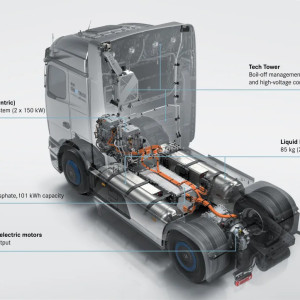
The newly unveiled Mercedes-Benz NextGenH2 Truck represents the next development phase of the company’s fuel cell programme, with Daimler Truck planning a limited production run of 100 vehicles from the end of 2026. The trucks are expected to enter customer fleets in real-world transport operations as Mercedes-Benz gathers operational data ahead of wider production planned for the early 2030s. Mercedes-Benz says the NextGenH2 combines proven hydrogen technology from its original GenH2 prototype programme with a number of production-ready components already used in the battery-electric eActros 600.
Those include the integrated e-axle, the aerodynamically optimised ProCabin design, the latest Multimedia Cockpit Interactive 2 system and a suite of updated driver assistance and safety systems. The truck uses liquid hydrogen storage technology developed jointly with industrial gases specialist Linde, allowing significantly greater energy density than gaseous hydrogen systems. Mercedes-Benz says the truck’s twin liquid hydrogen tanks can store up to 85kg of hydrogen and deliver ranges well beyond 1,000km at full payload.
Refuelling is expected to take between 10 and 15 minutes, bringing operating patterns much closer to conventional diesel trucks than current battery-electric alternatives. At the heart of the NextGenH2 is Daimler Truck and Volvo Group’s jointly developed cellcentric BZA150 fuel cell system. The truck uses two 150kW fuel cell units to provide a combined system output of 300kW.
Mercedes-Benz claims the hydrogen drivetrain has already demonstrated strong efficiency in testing, with early customer trials returning hydrogen consumption figures between 5.6kg and 8kg per 100km depending on operating conditions and payload. The manufacturer also highlighted the importance of liquid hydrogen technology specifically. Executives argued liquid hydrogen allows greater onboard storage capacity and lower tank weight than gaseous hydrogen systems, improving payload potential and helping fuel cell trucks achieve parity with diesel vehicles in long-haul operations.
Mercedes-Benz previously demonstrated the technology’s long-distance capability during its HydrogenRecordRun in late 2023, when a GenH2 prototype covered 1,047km on a single tank of liquid hydrogen at around 40 tonnes GCW.

Fuel cell trucks targeted at long-haul operations
During the UK presentation, Mercedes-Benz said its forthcoming GenH2 fuel cell truck would effectively “pick up from where battery-electric trucks left off”, targeting ranges between 600km and 1,000km on a single fill. The manufacturer revealed that start of production for the GenH2 has now been pushed back from 2027 to around 2030 due to infrastructure limitations in the UK and wider European market. Despite the delay, executives insisted the commitment to hydrogen fuel cell technology remains firm.
When questioned whether Mercedes-Benz was fully committed to hydrogen, representatives confirmed the company remains actively invested in the technology but believes the surrounding ecosystem must mature before large-scale deployment can succeed. The company argued there is little value in launching vehicles into a market that lacks the infrastructure and hydrogen production capacity required to support them commercially. According to Mercedes-Benz, the UK currently has only around nine hydrogen refuelling stations, making nationwide operation unrealistic for most fleet operators.
Cost also remains a major barrier. Executives stated hydrogen currently costs between GBP15/kg and GBP21/kg in the UK, while commercial viability for operators would require pricing below GBP5/kg. Mercedes-Benz also raised concerns around the carbon intensity of current hydrogen production methods.
The company warned that much of the hydrogen available today is still produced using carbon-intensive processes, meaning operators could simply be shifting emissions elsewhere in the supply chain rather than genuinely decarbonising transport operations. Executives said these concerns partly explain why Mercedes-Benz has prioritised battery-electric trucks in the short term.
Hydrogen combustion emerges as major talking point
While fuel cell technology formed a central part of the discussion, the most notable development was Mercedes-Benz’s detailed explanation of its hydrogen combustion strategy. The manufacturer said hydrogen combustion could prove particularly effective for vocational and construction operations where battery-electric technology faces payload and operational limitations.
Mercedes-Benz argued that the ability to deploy mobile and temporary refuelling infrastructure is critical within construction environments, where sites frequently change location and permanent fuelling facilities are impractical. The company explained that fuel cell vehicles require liquid hydrogen stored at extremely high pressures, whereas hydrogen combustion systems can operate using gaseous hydrogen that is easier to transport and refuel in mobile applications. Executives suggested this distinction makes hydrogen combustion particularly attractive for sectors such as construction, quarrying and vocational work.
Mercedes-Benz also pointed to JCB’s hydrogen engine programme as evidence that the construction sector increasingly sees combustion hydrogen as a viable route to decarbonisation. The discussion reflects a broader industry debate about whether battery-electric technology alone can meet the operational demands of every commercial vehicle segment. During the presentation, Mercedes-Benz acknowledged that payload remains one of the biggest challenges facing battery-electric trucks in construction applications.
Executives said every additional battery pack adds approximately 1.5 tonnes to chassis weight, creating significant compromises in sectors where payload directly affects profitability. The manufacturer admitted this was one reason it initially focused on long-haul distribution rather than construction, arguing that trunking operations offered the greatest immediate CO2 reduction potential. However, Mercedes-Benz confirmed it still sees a future for battery-electric construction trucks and indicated future eArocs variants remain under consideration alongside hydrogen-powered alternatives.

Battery-electric remains the immediate focus
Although hydrogen generated much of the interest, Mercedes-Benz made clear that battery-electric trucks remain the centrepiece of its current strategy.
The company highlighted what it described as a breakthrough year for electric truck adoption in the UK market. Mercedes-Benz claimed it achieved a 49.4% market share in battery-electric truck sales last year, with executives stressing that the majority of vehicles were sold based on total cost of ownership rather than grant funding alone. Executives said approximately 90% of registrations were driven by commercially viable customer use cases rather than purely by government-backed demonstration projects.
Amazon formed a major part of that growth, with Mercedes-Benz confirming it supplied 147 electric trucks to the retail giant last year. The manufacturer also used the presentation to heavily promote the eActros 600, which it described as the most efficient truck currently available in the market. Mercedes-Benz said the truck has demonstrated real-world ranges exceeding 500km while operating at 40 tonnes GCW, with some operators reportedly achieving significantly higher figures.
Executives also pointed to battery technology improvements, particularly the shift toward lithium iron phosphate batteries, which they said are better suited to intensive commercial charging cycles than previous nickel manganese cobalt battery systems. The OEM claimed the eActros 600 now offers a 1.2 million kilometre, 10-year design life comparable to diesel trucks, helping address concerns around long-term durability and residual values.
Government grants transform the business case
A major theme throughout the presentation was the growing role of government support in accelerating electric truck adoption. Mercedes-Benz repeatedly highlighted recent changes to UK grant schemes, arguing they have transformed the economics of battery-electric trucks.
The company welcomed the replacement of the Plug-in Truck Grant with the new Zero Emission HGV and Infrastructure Demonstrator support package, which can now provide up to GBP81,000 per truck and support as many as 100 vehicles per operator. Executives described the move as “game-changing” for total cost of ownership calculations. Mercedes-Benz also highlighted the expanded Depot Charging Scheme, which can cover up to 70% of infrastructure installation costs, capped at GBP1 million.
According to the manufacturer, infrastructure costs remain the single biggest obstacle preventing many operators from switching to electric trucks. Executives argued the latest grants substantially reduce that barrier and improve financing costs by lowering the overall capital value operators must fund. The company claimed operators charging at around 21p/kWh could achieve savings of approximately GBP46,000 over a five-year operating cycle compared with diesel equivalents.
Where operators secure electricity prices closer to 15p/kWh, Mercedes-Benz suggested savings could rise to around GBP90,000 across the vehicle lifecycle.

TruckCharge strategy expands beyond vehicles
Mercedes-Benz also used the event to outline its broader TruckCharge strategy, which aims to position the manufacturer as a full-service infrastructure provider rather than solely a vehicle supplier. The company confirmed it is installing high-power charging infrastructure at its Milton Keynes headquarters as part of plans to electrify its own logistics operation. Mercedes-Benz said dealers across the UK will eventually be able to provide a “one-stop-shop” approach covering trucks, charging hardware, infrastructure consulting and civil engineering support.
Executives argued this integrated approach removes complexity for operators and simplifies the transition to zero-emission transport. The company also revealed it has developed a new interactive total cost of ownership tool that allows dealers to model different fleet electrification scenarios live with customers. Mercedes-Benz believes the tool will help accelerate adoption by allowing operators to instantly see how factors such as electricity pricing, mileage, grants and charging infrastructure affect long-term operating costs.
A broader shift in industry thinking
Perhaps the most important takeaway from the presentation was the growing acknowledgement that no single technology is likely to decarbonise every heavy vehicle application.
Mercedes-Benz repeatedly emphasised that battery-electric, hydrogen fuel cell and hydrogen combustion systems will each have distinct roles depending on operational requirements. That position mirrors a wider trend emerging across the commercial vehicle sector, where OEMs increasingly appear to be abandoning the idea of a universal solution in favour of application-specific technologies. For now, Mercedes-Benz sees battery-electric trucks as the fastest route to large-scale emissions reduction in mainstream haulage operations.
But by openly committing to both fuel cell and hydrogen combustion technology, the manufacturer has signalled that it believes hydrogen will still have a significant role to play in the future of UK road transport — particularly in sectors where batteries alone may struggle to deliver the required range, payload or operational flexibility.