IVECO UK MD Mike Cutts outlines growth ambitions, decarbonisation strategy and market concerns

IVECO UK Managing Director Mike Cutts has highlighted market uncertainty, decarbonisation challenges and future growth opportunities during an interview discussing the state of the UK haulage sector and the manufacturer’s long-term ambitions. Speaking to Trucking Magazine, Cutts described the current market as “commercially challenging”, pointing to weak operator confidence, rising costs and continued pressure on fleet margins. “The bigger are getting bigger and the smaller are disappearing,” he said, noting that consolidation within the haulage sector has accelerated as smaller operators struggle to absorb operating costs and maintain profitability.
According to Cutts, the UK truck market has continued to slow during the opening months of the year, with operators remaining cautious about making long-term investment decisions amid wider economic uncertainty.
Tata acquisition a major focus
One of the most significant developments for the business is the ongoing acquisition involving Tata Motors, which Cutts said will effectively double the scale of both organisations’ commercial vehicle operations. He described the move as a “really exciting opportunity” that will strengthen investment capability, support future technology development and help secure the long-term future of the business in an increasingly competitive global market.
Multi-fuel strategy remains central
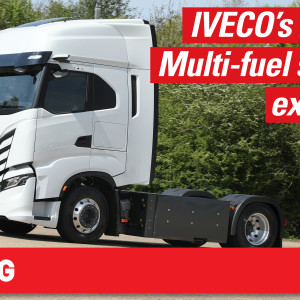
Decarbonisation formed a major part of the discussion, with Cutts reaffirming IVECO’s commitment to a multi-fuel strategy rather than focusing solely on battery-electric vehicles. He argued that compressed natural gas (CNG) and liquefied natural gas (LNG) continue to offer operators practical and commercially viable pathways towards reducing emissions, particularly within long-haul applications.
“When CNG can decarbonise a truck by 95%, that’s a fair way to go,” he said. Cutts also suggested government policy remains too heavily focused on zero-emission technology alone, while insufficient attention has been given to transitional solutions and supporting infrastructure. IVECO currently offers diesel, HVO-compatible vehicles, CNG, LNG and battery-electric products across its range, with hydrogen technology also planned for the future.
Electric truck challenges remain
While positive about the long-term future of battery-electric trucks, Cutts identified vehicle cost parity and charging infrastructure as the two biggest barriers currently facing operators.
He welcomed recent government grant support for electric trucks but warned that uncertainty around future incentives could slow investment decisions. Infrastructure limitations were also highlighted as a major concern, particularly for operators attempting to secure sufficient grid capacity at depots. “A huge amount of investment is needed within infrastructure to really make the BEV experience positive and workable for operators,” he said.
Driver experience and connectivity
Cutts also discussed the growing importance of driver comfort and retention, explaining how vehicle design is increasingly focused on improving the day-to-day working environment for drivers.
Features including upgraded seating, improved cab ergonomics, smartphone integration, voice controls and advanced safety systems were all identified as important developments helping operators attract and retain drivers. Connectivity and predictive maintenance technology were another major focus, with Cutts describing connected vehicle systems as one of the most underrated innovations in modern trucking. IVECO’s connected vehicle platform allows operators and dealerships to monitor vehicle performance remotely, helping reduce unplanned downtime and improve operational efficiency.
According to Cutts, connected trucks can improve uptime by as much as 22% by allowing preventative maintenance issues to be identified before breakdowns occur.
Ambition for 10% UK market share
Looking ahead, Cutts said his long-term ambition is for IVECO to achieve a 10% share of the UK truck market while continuing to reposition the brand further towards the premium end of the sector.
He said recent investment in products, dealer support and customer experience would help build the foundations for future growth once market conditions improve.
Cutts also predicted that the commercial vehicle industry would continue moving towards a broader mix of alternative fuels, increased electrification and greater use of AI-driven technologies over the next decade.
[embedded content]