Which UK Roads are Speeding Hotspots? 2026 Update
Speeding remains a leading cause of collisions, injuries, and rising operational costs for businesses. With hundreds of thousands of tracked vehicles crisscrossing the UK every day, the vehicle tracking technology provides a unique view of driving behaviour on the nation's roads. From busy motorways to quiet rural lanes, we continue to analyse anonymised data points within the SafeSpeed database to reveal where speed limits are broken most often.
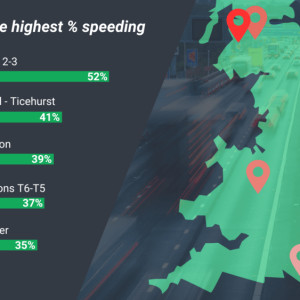
UK speed hotspots: What the 2026 data shows The updated 2026 analysis reveals notable changes in UK speeding patterns compared to the 2024 data. Speeding percentages have increased significantly across several key routes.
- M77 Junctions 2-3: 52% of traffic speeding (NEW to the top 5)
- This stretch of the M77 in Scotland now tops the list, with over half of all traffic exceeding the 70mph speed limit
- B2087 Flimwell - Ticehurst: 41% of traffic speeding (NEW to the top 5)
- This East Sussex B-road shows a high speeding rate despite being a smaller, rural route
- B756 Uddingston: 39% of traffic speeding (NEW to the top 5)
- This route in South Lanarkshire shows concerning speeding levels
- M6 Toll Junctions T6-T5: 37% of traffic speeding (DOWN from 46% in 2024)
- While still in the top five, this route has seen a 9 percentage point decrease in speeding.
This formerly topped the 2024 list between Tamworth and Burntwood junctions
- While still in the top five, this route has seen a 9 percentage point decrease in speeding.
- C147 Chichester: 35% of traffic speeding (NEW to the top 5)
- This Hampshire route is a classified unnumbered road - often quieter routes

UK speed hotspots: What the 2024 data shows The data highlights several key locations where speeding is particularly prevalent. Topping the list of the speediest road sections is the M6 Toll road, between the Tamworth and Burntwood junctions (T6 and T5), with 46% of traffic travelling above the 70mph speed limit.
Over 40% of traffic also exceeds the posted speed limit around the Horwich Interchange near junctions 6 and 8 of the M61. We analysed around 10,000 data points from these road sections over a year. Higher speeds may be due to light traffic or road design encouraging faster driving.

While segments of major motorways like the M6 and M61 show the highest levels of speeding, smaller, lower speed A and B roads are not immune.
In fact, certain sections of the roads listed below see over 20% of traffic exceeding their speed limit, highlighting the need for careful monitoring across all road types. When smaller samples of 1000-6000 data points are examined, these road sections emerge as being most prone to excessive speeds:
- B4590 in Willenhall, Walsall
- A4098 in Walsall
- B2199 in Petersfield, East Hampshire
- B2001 in the Isle of Grain, Kent
Notably in the sample, the speed limit was not exceeded on the following sections of roads. These road segments may have stricter enforcement, higher traffic volumes, or design features that successfully discourage speeding.
- M6 between junctions 21-26
- M621 between junctions 2-4
- M4 between junctions 24-26
- M42 between junctions 4-7
- A12 between 25-36 and 14-15
- A55 between junctions 15-16
Exceeding the speed limit is a key risk factor for road traffic collisions.
However, the way that people drive also has an impact on safety, as does driving at an appropriate speed for the condition of the road. Ensuring we stay below the speed limit is one of many ways we can improve road safety. Key Changes from 2024 to 2026
- The M6 Toll has seen a notable 9 percentage point reduction in speeding (from 46% to 37%), though it remains problematic
- The M77 Junctions 2-3 has emerged as the UK's most significant speeding hotspot at 52%, surpassing the M6 Toll's previous 46% rate from 2024
- Three new locations have entered the top five, suggesting speeding issues are shifting to different areas of the UK
- Scottish roads feature more prominently in 2026 data, with both the M77 and B756 making the list
Measuring driver behaviour and risk
The vehicle tracking system helps over 35,000 businesses improve fleet safety, efficiency, and reduce costs by providing a comprehensive view of driver behaviour and vehicle use. It flags risky actions like speeding, fast acceleration and harsh braking, allowing businesses to take proactive steps. Individual driver scores identify those posing a high risk behind the wheel.
Quartix fleet tracking users can reduce speeding instances, collision rates and fuel economy across their business fleet by paying close attention to driver league tables, often incentivising improvements within their teams. One customer with a fleet of over 400 vehicles saw a 65% reduction in accidents, a 12% increase in fuel efficiency, and over GBP150,000 in maintenance savings within one year of using the system and implementing SAFED training. The unique SafeSpeed database adds a further measurement of safety - drivers are also scored against the average speed of other vehicles on the very same sections of road.
This relative speed scoring is a valuable benchmark for rural roads, where it is often not safe to drive as fast as the posted speed limit.
Transport & Logistics Magazine - Driving The Industry Forward