12,000 miles in the new Ford Capri: Enjoyable, yet overpriced
 21 May 2026
It’s really nice to be back in a Ford. The marque used to provide a motoring bedrock for me and millions like me in the UK but, despite the success of the Puma[1], that has faded largely away. It’s the lack of a full model line that has done it.
New Fords[2] used to be a common sight; now they aren’t. Of course, this new Capri[3] I’m driving is a very different kind of Ford – it’s a Volkswagen ID 4[4] underneath – and Ford’s European model range has changed almost out of recognition. But it’s still nice to reinstate one of the givens of a motoring lifetime.
It’s still amazing to me that the Fiesta[5], for most of its 47 years the UK’s best-seller, has been dead since 2023 and that the Focus[6], once as ubiquitous as the Volkswagen Golf[7], has joined it in the cemetery. As a way of healing the gap, Ford did a deal with Wolfsburg to use its MEB platform for the blocky Explorer and slightly sleeker Capri. Even though that doesn’t sound a very convincing scenario, this pair are fairly convincing as Fords, even if they are expensive.
My new Capri RWD Extended Range Premium (GBP4000 cheaper than the top-spec AWD version) still runs to GBP53,235, even after a GBP4000 ‘contribution’ from Ford to make the prices look a little better.  There are five options, totalling GBP5050: vivid blue paint, the Driver Assistance Pack (whose only real asset to me is a head-up display), a heat pump (which I’d have thought an essential in an EV of this price), a retractable towbar and a set of rather shouty 21in alloy wheels.
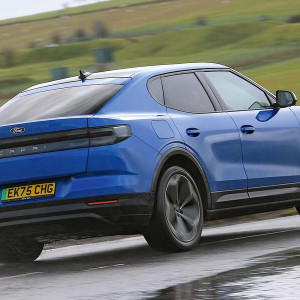
This modern Capri isn’t exactly handsome – being rather too high and too snub-nosed for that rear quarter window to really recall the much-loved old coupe – but has nevertheless grown on me, as any car does when it performs well.About the whys and wherefores of Ford’s use of this famous name I will pass over: too much nonsense has been voiced about that already. I think Mondeo[8] when I drive my Capri. Since the 1990s, when mainstream Fords[9] were reborn as cars with class-leading dynamics, these have been models with very good steering, excellent cornering and impressively effective dampers, and the Capri seems all of that.
With caveats: it’s quite tall, so I wouldn’t call it chuckable. But it does grip and turn in nicely and its grip limit is too high to explore on the road (perhaps helped by 235/45 tyres). It understeers a bit when pressed beyond comfortable levels and, despite the traction control, you can spin the rear wheels on rapid departures (it does have 282bhp and 402lb ft of torque), but it’s mostly a stable, enjoyable, easy-driving platform anyone can handle – like Mondeos always were.
 The ride can occasionally be choppy (like on previous Fords), but the advantage is a feeling of tautness and an absence of ‘echo’ when a wheel hits a bump. You just get a nice, clean thump.
Fords claims a range of 370 miles for this RWD car, from its 77kWh battery, or 289 miles on the motorway. Both figures, as we have come to expect, are wrong in practice, at least at this time of year. Charge the Capri to 100% (you have to request this via the central touchscreen, else it will stop at 80%) and you will be offered 290-310 miles.
Keep off motorways and you will get a creditable 3.6-3.9mpkWh and all the mileage initially offered. I cruise on motorways at 65-70mph, depending on gradient, and feel I can depend on 260-280 miles (at 3.2mpkWh), which isn’t bad at all.If I can find a fast enough charger, the Capri will accept 185kW and go from 10% to 80% in less than half an hour – but again, as we have come to expect, these are fantasy figures. Inside, the trim is of universally good quality and the front buckets especially have won plaudits from all comers for comfort.
The interior seems vast: why a five-seater would need a bigger cabin I can’t think.  Capri’s boot is 102 litres bigger than that of the squarer Explorer.
The boot is wide and long but not very deep, but there’s a permanently fitted cover that rises with the tailgate and causes less trouble than any I can remember. So far, I’m having a good time with the Capri. I appreciate its Ford-like steering, excellent seats, near-silence and pace.
Its touchscreen works well and is easy to fathom. I’m far less impressed by the poor design and ergonomics of the steering wheel switches and the crude instrument layout: it makes me yearn for a Focus’s handy and sensible layout. But it’s not a major fault – the functions are all there – and I suppose I’ll get used to it.
An unnecessary journey didn’t go to waste
It was the closest thing I can remember to a completely wasted journey.
I set off in my Ford Capri from home in Gloucestershire midway through a Sunday afternoon – when I could instead have been watching an absorbing Six Nations game on TV – in order to position myself in good time for an early Monday morning meeting in London. Just outside London I learned the crucial meeting had been cancelled. The only sensible thing to do was to pull a U-turn and spend another 2 hours getting home – but this gave me the ideal opportunity to test the Capri’s touring credentials.
Read the full feature here[10]
More range, more praise
The good times are rolling again. The arrival of early spring weather has brought a handy, if variable, improvement in the already-decent range that our Ford Capri offers when you charge it to 100%. Ford promises 370 miles on the WLTP scale, and I suspect our car will get close to that when the temperature rises into the 15-20deg C range, but at present, with the ambient around 10deg C, I’m usually offered 320-340 miles-which is plenty for my kind of usage.
I’m contemplating a trip to Cornwall in a few days to view progress with the revival of my 1990 Peugeot 205 GTi rally car[11], and the 400-mile round trip from Gloucestershire will require only one half-hour charging session, probably at Exeter, which is a decent place for a restorative breakfast (I’ll be leaving early).  The Capri’s improving range also means I can start doing what’s best for the battery and limiting charge to 80%, which is the car’s default setting.
If you want to charge it fully, you have to select 100% every time on the central touchscreen. But 80% gives you 260-270 miles, which is plenty for all but the longest journeys. Talking about long journeys, the Capri is good at them.
If you stick to around 70mph and avoid the unnecessary acceleration up hills that drivers of similarly sized (and rather less powerful) ICE cars seem to specialise in, you can depend on 250 cruising miles, which is a decent performance, since you’re in a speed range where aerodynamic drag severely saps on-board energy. Go 5-10mph slower and you will get an extra 20 miles: it’s a game of chess. The Capri is spacious and comfortable for cruising.
The seats feel large, supportive and firmly comfortable, yet they leave plenty of room for large rear passengers’ knees and feet. Only the driver’s seat gets electric adjustability and lumbar support, whereas the front passenger misses out, which seems a distinctly old-school Ford-style cost-saver: back in the day, certain boggo Blue Oval models used to save money by leaving out the passenger’s sunvisor and the glovebox lid… Two other criticisms.
First, this Ford is a Volkswagen ID 4 underneath and, like many German cars brought up to spend their lives on finely surfaced roads, it generates more tyre noise than others in the class. British road surfaces are slowly getting quieter, but there are still plenty of places where you have to turn up the radio volume to hear any detail over the roar. 
Second, visibility: the cowl is high and the pillars are thick, so you have to steer accurately so as not to nerf kerbs and keep a special lookout for cyclists hiding behind pillars. You get used to it but, on your way to familiarity, you may have the odd ‘close one’. Not ideal.
The generosity of space extends to the boot, which is big and flat-bottomed, and there’s a further deep compartment (ideal for the charging lead) under a false floor, which makes up for the fact that this big and tall car doesn’t have a frunk, unlike so many of its peers. Praise is also due to the fabric luggage cover, which is cleverly attached to the tailgate such that it moves out of the way when you open up. It’s the only such cover I can remember that doesn’t require regular wrestling to get it out of the way.
Looking back through this, I seem to have carped quite a bit, but the truth is I’ve found my usual 2000 miles a month really easy to do in this car, because it’s simple and enjoyable to drive, I don’t need to stop much away from home to charge it, it has all the power I could possibly need and I can detect the input of Ford’s dynamics experts, at least in the steering. I’ll be sorry when it goes.
Sunshine boosts range for more spirited driving
Good news to start. After a shade under 10,000 miles of driving, the Capri’s average energy consumption has just edged up a notch to 3.6 miles per kWh from the perfectly decent 3.5 that has ruled for at least the past 5000 miles.
At first I sought to pat myself on the back for continuing to learn to drive the car better – until some office spark pointed out that the weather is getting warmer and batteries work better in those conditions. Whatever, the Capri continues to impress with its practicality, having a dependable 300-mile range, provided my driving isn’t all motorway (260 miles if it is), and showing a toughness and tautness that lifts it away from many EVS of similar size and weight, whose suspensions show an inability to cope with mass by allowing regular wheel wind-up on bumpy sections and by allowing too much bounce and too little composure. 
I started life with the Capri complaining (not too vehemently) about its tendency to lumpiness, and that is still a minor foible, but I cheerfully accept it for the car’s built-in tautness and its ability to deal with big bumps in one rubber-footed impact, rather than with echoes in the structure, which dog quite a few of the less capable, often Chinese rivals. The energy consumption improvement might have been even better had I not realised that I had dropped into the habit of stroking this car about without much elan, rarely making use of its very decent acceleration and firm, accurate, Ford-specified steering (in a predominantly VW chassis). One afternoon recently, when nothing much was happening at home or in the office, I set off on a half-serious sprint on a secret test track I have near home, which takes in enough motorway to connect two junctions, a couple of tightly packed villages, about 15 miles of sinuous roads along which you can usually see the apex after next and some adverse surfaces.
The idea was to feel the performance in this car, of which there is plenty. It’s a big car and fairly fat, and you sit quite low in it, sighting just over the steering wheel and along the bonnet, so it takes time to clip apices yet avoid wheel damage. But after doing quite a bit of this, I’d put steering as the Capri’s top virtue.
Second is its wet grip. You start life with this car being conscious of its 2.1-tonne kerb weight and wary in the wet, but it soon demonstrates an ability to hold on strongly and never slide. It will understeer a bit if seriously provoked, and in a slippery high-speed corner I did once get its rear wheels to step sideways a foot under power, but mostly it’s on rails.
There’s only a hint of body roll and the supportive seats hold you in place well.  Two beefs: the optional 21in Continental tyres (unusually, a shade wider at the rear than the front) are quite noisy on the UK’s frequently coarse road surfaces – although I’ll bet this comment would never arise in France or Germany, where they know more about surfacing modern roads.
More serious is the feel of the brake pedal, which delivers good retardation when you begin to stop but feels oddly less responsive in the meat of a brisk application. Push harder and the car stops effectively but the pleasure of linear, easily modulated braking definitely isn’t present. That hasn’t spoiled the Capri for me, though.
I like it.
VW base and name are forgiven – but the price?
After 12,000 miles of driving a new-era Ford Capri, all of my doubts except one faded away. At the outset there were several: the size, the price, the fact that this Ford was actually a Volkswagen underneath and the use of the hallowed Capri name, which bothered so many people. My bottom line, delivered here rather than later, is that even though the car departed a month ago and has been replaced by an interesting parade of rivals, I still think about it quite a lot and wish it were still around.
It was a good car, but not the price. When the Capri first hit the UK market 18 months ago, four or five months after its Explorer sibling, Ford was taking bucketloads of criticism for its distinctly ropey grip on the affordable car market that it had previously commanded. It had scuppered the Fiesta and Focus (by announcing their demise) as part of an apparent frenzy to close European factories; and while rivals launched well-planned EV model ranges, its only electric offering was the American Mustang Mach-E, a decent car whose face has never quite fitted here.
The Explorer and Capri were rushed into service during 2024 using underbits from VW’s decent ID 4 and ID 5 to save time and cost, but that move meant the new Fords would have to abide by VW’s prior conclusions about size, weight, cost and mechanical make-up, whereas we Ford watchers had become used to the Blue Oval making its own, usually wise, decisions about such vital stuff for its everyman buyers. Ford’s strategy collided particularly heavily with the heady days of the Focus that some of us remembered, when that seminal Escort replacement lifted the standard of family hatchbacks so comprehensively across the board that every other competitor, including VW, had to respond in a hurry. Small wonder that the Explorer and Capri were seen as, well, a hit me-too.
 However, when we started driving the Explorer and then the Capri, they seemed quite decent Fords, as long as you had never seen an ID 4’s dashboard. They also brought a lot of latest-generation EV virtues: principally decent battery ranges and excellent interior space.
Lots of critics emerged from the woodwork when they divined that the fastback version of the Explorer had been christened Capri, as part of a decision made in the US to utilise famous Ford names for new cars that needed a profile. Both sides were at fault, I reckon: Ford for its naivety in not recognising people’s emotional attachment with the Capri name (used for 18 years on the Cortina coupe that “you always promised yourself”) and the critics who never realised that this was the fourth time that the Capri name had been used on a Ford family product: their favourite had been the third. When my RWD Extended Range Capri arrived, resplendent in an GBP800 optional Blue My Mind paint job, it looked very big – very tall.
That Capri-like curved rear window and its fastback hatch was a very long way off the floor. With its SUV-ish roof height, high bonnet and short overhangs, in profile the car looked a bit more like a house brick than a coupe. It wasn’t unpleasant, but it was certainly different.
When I drove it first, it seemed very wide too, although that was probably exaggerated by the fact that my previous daily had been a Renault 5. First impressions were of great seat comfort – an impression that persisted for the life of the Capri with us – but a certain lumpiness in the ride. However, this was overtaken by an appreciation of its pretty good damper control, which made this 2.2-tonne machine feel taut and controllable in corners.
 As I’ve written before, the steering is a particularly good feature of the Capri, taking me back a decade or two to the golden age of European Fords. Every time I returned to this car after time in something else, I was glad of those messages through the thick-rimmed wheel.
This was a relatively quiet-cruising car, too, despite its big tyres. The dependable 260-280-mile cruising range at 70mph helped too. I’d definitely recommend the 77kWh battery to any prospective buyer.
At lower speeds, 300-310 miles is practical, although you’re unlikely to achieve the 389 miles claimed in the brochures. The only dynamic bit I didn’t much like was the brake feel. The Capri can stop absolutely as briskly as it needs to, but the pedal isn’t as easy to modulate as many (and those Fords of the good old days).
Pulling off a smooth halt at a stop sign requires unusual care and the brakes’ behaviour amid a stop isn’t great. The initial retardation is good but you have to press harder to keep stopping at the same intensity. Not dangerous, just weird.
I soon became used to the Capri’s size (especially the width), helped by the precise steering and at least not hindered too much by its high sides and indifferent visibility. In 12,000 miles I managed never to kerb a wheel (although the clever protruding rubber collars on the front tyres helped once or twice). 
My main bugbear was the price: now just over GBP50k with an option pack like mine, after two apparent reductions that had it starting at an eye-watering GBP57,000. In this age of burgeoning, low-priced Chinese competition, I suspect the price is still a reason you don’t see many Explorers or Capris about. On vehicle merit alone, that’s a shame.
Ford Capri RWD Extended Range Premium
Prices: List price new GBP52,095 List price now GBP51,735 Price as tested GBP57,235
Options: Driver Assistance Pack GBP1300, heat pump GBP1050, 21in alloy wheels GBP1000, retractable towbar GBP900, Blue My Mind paint GBP800 Economy and range: Claimed range 389 miles Battery 77kWh (usable) Test average 3.5mpkWh Test best 4.2mpkWh Test worst 2.2mpkWh Real-world range 270 miles Max charge rate 135kW Tech highlights: 0-62mph 6.4sec Top speed 111mph Engine Permanent magnet synchronous motor Max power 282bhp Max torque 402 lb ft Gearbox 1-spd reduction gear, RWD Boot 572/1505litres Wheels 8.5Jx21 (front), 9.0Jx21 (rear) Tyres 235/45 R21 (front) 255/40 R21 (rear) Continental Ecocontact Kerb weight 2114kg
Service and running costs: Contract hire rate GBP447ppm CO2 0g/km Service costs None Other costs Front and rear tyre, GBP520 Fuel costs GBP1890 (est) Running costs including fuel GBP2410 (est) Cost per mile 19 pence Faults None
 Title: Editor-in-chiefFollow:
Steve Cropley is the oldest of Autocar’s editorial team, or the most experienced if you want to be polite about it. He joined over 30 years ago, and has driven many cars and interviewed many people in half a century in the business. Cropley, who regards himself as the magazine’s “long stop”, has seen many changes since Autocar was a print-only affair, but claims that in such a fast moving environment he has little appetite for looking back.
He has been surprised and delighted by the generous reception afforded the My Week In Cars podcast he makes with long suffering colleague Matt Prior, and calls it the most enjoyable part of his working week.
Subscribe[12]
Never miss an issue of the world’s oldest car magazine – subscribe to Autocar magazine today.Subscribe[13]
References
- ^ Puma (www.autocar.co.uk)
- ^ Fords (www.autocar.co.uk)
- ^ Capri (www.autocar.co.uk)
- ^ Volkswagen ID 4 (www.autocar.co.uk)
- ^ Fiesta (www.autocar.co.uk)
- ^ Focus (www.autocar.co.uk)
- ^ Volkswagen Golf (www.autocar.co.uk)
- ^ Mondeo (www.autocar.co.uk)
- ^ 1990s, when mainstream Fords (www.autocar.co.uk)
- ^ Read the full feature here (www.autocar.co.uk)
- ^ Peugeot 205 GTi rally car (www.autocar.co.uk)
- ^ Subscribe (www.autocar.co.uk)
- ^ Subscribe (www.autocar.co.uk)