The biggest traffic jam in Wales which has caused more anger and arguments than any other stretch of road
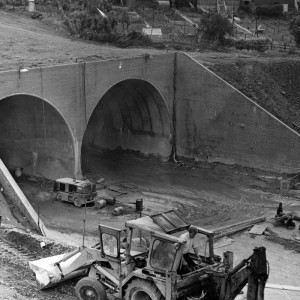
The Brynglas Tunnels once represented pioneering motorway infrastructure, today the story is very different

04:45, 25 Apr 2026
 View 5 Images
The Brynglas Tunnels opened in 1967(Image: Mirrorpix)
Once a triumph of 1960s engineering, the Brynglas Tunnels are now one of the most notorious bottlenecks in the country.
When the tunnels opened in 1967 they represented cutting edge British motorway engineering, transforming travel between south Wales and London.
Almost six decades later, for many in south Wales the short stretch of road is one of daily frustrations as traffic crawls around Newport. The once ambitious infrastructure is now an ageing relic which is regularly debated by politicians, businesses, and environmentalists.
The traffic corridor pretty much everyone across Wales will be familiar with has been a topic of heated debate as politicians scrape their heads to try and figure out how to fix the problem of a two-lane section of motorway set in a hillside.
The spot is one of the most congested points of the M4[1], causing backlogs every day for drivers between Newport[2] and Cardiff[3], and very few regular M4 users can attest to never having been stuck in a bottleneck there. For the biggest stories in Wales first sign up to our daily newsletter here[4].
During an inquiry into the motorway, former Prime Minister David Cameron described the tunnels as a “foot on the windpipe of the Welsh economy”.
 View 5 Images
The Brynglas Tunnels under Brynglas Road(Image: Mirrorpix)
History
Motorways haven’t always defined UK travel.
As post-war Britain saw a huge rise in car ownership amid a drive to improve the economy, motorways began being built across the country.
It soon became clear links between south Wales and London needed to improve as they were solely connected through the A48.
The road’s hills and tight bends meant delays and jams were inevitable and anyone driving to England from anywhere further west of Newport would have to drive through the city.
The M4, originally known as the London-south Wales motorway, transformed travel around and into south Wales improving Wales’ recovery from the Second World War and accelerating the movement of people and goods between Wales and London.
Welsh historian Dr Martin Johnes once called the motorway “the most important place in Welsh history”.
However, navigating the motorway around Newport proved challenging due to urban density, the River Usk, and the surrounding hills. The best solution to these problems was to build the Brynglas Tunnels on the M4 bypass around Newport, under Brynglas Road and through Brynglas Hill.
On May 5, 1967, they opened. The 360m tunnels were the first on any British motorway and remain as the only twin-bored tunnels on any UK motorway today.
The ?3m project was led by civil engineer Owen Williams who was also responsible for other major projects including the old Wembley Stadium and the M1.
 View 5 Images
Construction of the tunnels in May 1963(Image: Mirrorpix)
Despite it being the first of its kind, this transformative section of the motorway was never without its challenges.
During construction, a number of houses on Brynglas Road, the road which runs over the tunnels, had to be demolished and the families re-homed.
Although the engineering seemed rather advanced at the time, almost as soon as the bypass was completed it was out of date due to an ever-growing number of road users
The tunnels were originally planned to take up to 30,000 vehicles a day but the true figure has since far surpassed this.
The exponential growth in road travel since the tunnels were built has seen much of the rest of the carriageway expanded to three lanes. However, because extra lanes couldn’t be added to the tunnels they create a bottleneck at peak times.
The tunnels have no hard shoulder and were designed for a much lower traffic volume. The lack of a hard shoulder also means accidents and breakdowns can have a disproportionate impact on traffic across the south Wales road network.
Since they were built there have been some updates including variable speed limits, lane control, and safety upgrades to lighting and signage.
The fundamental congestion challenges do however remain.
 View 5 Images
The burnt out lorry still in the westbound tunnel of the M4(Image: Gareth Everett/Huw Evans Agency)
On July 26, 2011, a lorry set on fire in the westbound tunnel. No fatalities were reported but the incident caused the tunnel to be closed for two days after the fire caused damage to the overhead gantry.
After the initial fire was put out, a contra flow system operated in the eastbound tunnel allowing one lane to travel in each direction.
25 firefighters spent almost four hours tackling the substantial blaze which proved how easily the motorway system could fall apart should a crisis unhold.
In 2020, the Welsh Government[5] confirmed that the stretch of motorway between junctions 25 and 26 (incorporating the Brynglas tunnels) was named the fourth most congested stretch of urban motorway in the UK and is ranked within the top 50 traffic hotspots in Europe.
Future
The issue of one of the most notorious congestion spots in the UK has been addressed time and time again by political parties in Wales.
In the 2010s the Welsh Labour[6] government looked set to back a new 14 mile six-lane stretch of motorway south of Newport designed to take the pressure off the tunnels.
A year after an 83-day public inquiry was held to assess the various options, Mark Drakeford’s government scrapped the entire plan. They cited high costs, estimated at the time to be ?1.6bn, and environmental factors.
It was later revealed that the cancelled project had cost taxpayers ?114m over six years, including the ?44m spent on a public inquiry.
 View 5 Images
The Brynglas Tunnels today(Image: John Myers)
A range of options have been cited over the years – described as the black, red, purple, and blue routes.[7] The black route, the one previously scrapped, would’ve seen a new three-lane motorway between junctions 23 (Magor) and 29 (Castleton), including a new crossing over the River Usk south of Newport.
The red route involved a dual carriageway being built south of Newport but further north than the black route.
Meanwhile, the purple route proposed a three-lane motorway along a similar route to the red route.
This option would also need a new crossing over the River Usk.
Another option was the blue route which would’ve used a combination of the A48 Newport Southern Distributor Road and the former Steelworks Road on the eastern side of Newport to create a new dual carriageway.
Article continues below
The tunnels are unlikely to disappear so for now traffic will need to be managed while the relief road debate murmurs on.
Greater transport investment could reduce reliance on the tunnels but ultimately whoever the issue is likely to remain for some time.
References
- ^ the M4 (www.walesonline.co.uk)
- ^ Newport (www.walesonline.co.uk)
- ^ Cardiff (www.walesonline.co.uk)
- ^ sign up to our daily newsletter here (www.walesonline.co.uk)
- ^ Welsh Government (www.walesonline.co.uk)
- ^ Labour (www.walesonline.co.uk)
- ^ the black, red, purple, and blue routes. (www.walesonline.co.uk)