Road freight stays weak; logistics giants defend margins
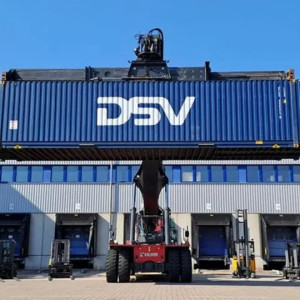

DSV's full-year figures[1] were dominated by the Schenker acquisition, which reshaped the company's road and contract logistics footprint and lifted reported earnings -- even as DSV described Europe as a market of weak activity and low freight rates, with domestic groupage remaining a drag on utilisation. DHL Group added another variation on the same theme: revenue dipped to EUR82.9bn, but EBIT rose to EUR6.1bn as network steering and cost discipline offset softer freight markets, while its forwarding arm still pointed to subdued European road conditions.[2] Kuehne+Nagel,[3] by contrast, reported broadly stable topline performance but a sharp profitability decline, and launched a CHF 200 million structural cost reduction programme late in the year to reset its cost base.
Its Road Logistics division saw EBIT fall to CHF 58 million, largely due to weakened demand for land transport activities in Europe. In contract logistics, GXO[4] again showed why warehousing and fulfilment can be more resilient in a low-rate cycle: full-year revenue rose to £13.2 billion and adjusted EBITDA increased to £881 million, supported by continued automation and the ongoing integration of Wincanton. C.H.
Robinson[5]'s 2025 results, meanwhile, reflected its reduced European exposure after divesting its Europe Surface Transportation business. The company focused its narrative on productivity and "Lean AI", while full-year revenues fell to £16.23 billion. Key financial performance (full year 2025)
| Company | Revenue | EBIT / Operating Income | Key Driver |
| DSV | DKK 247.3 billion (+51.3%) | DKK 19.6 billion (+24.8%) | Schenker acquisition and fast integration. |
| DHL Group | EUR82.9 billion (-1.6%) | EUR6.1 billion (+3.7%) | "Fit for Growth" efficiency program and active capacity management. |
| Kuehne+Nagel | CHF 24.5 billion (-1.3%) | CHF 1.24 billion (-24.9%) | Negative currency translation and volatile rates. |
| GXO | £13.2 billion (+12.5%) | £881 million (Adj.
EBITDA) |
Record new business wins and acquisitions. |
| C.H. Robinson | £16.2 billion (-8.4%) | £795.0 million (+18.8%) | Lean AI strategy and aggressive cost optimisation. |
DSV: Schenker-driven scale, but Europe road remains "challenging"
DSV closed 2025 with revenue of DKK 247.3bn, gross profit of DKK 66.9bn, and EBIT before special items of DKK 19.6bn, up from DKK 16.1bn a year earlier. The strategic story, however, is the integration.
DSV says it completed more than 30% of the Schenker integration during 2025, with completion now expected by end-2026 -- and with annual synergies expected to reach about DKK 9bn, with full financial impact expected in 2027. For road freight specifically, the company's reporting underlines how hard the underlying European market still is. DSV's Road division delivered gross profit of DKK 16.6bn (+116%) and EBIT before special items of DKK 2.74bn (+46.5%), with management attributing the jump mainly to Schenker's contribution.
At the same time, DSV describes 2025 road conditions as shaped by weak economic activity and macro uncertainties (notably in Europe), leading to reduced demand and low freight rates, with the weakest spot being domestic groupage in Europe, which it says hit utilisation and profitability. DSV does, however, flag signs of stabilisation towards the end of the year, "especially in Europe" -- a nuance that matters for hauliers watching whether the market has finally found a floor.
DHL Group: profit up despite softer freight, but European road remains subdued
DHL Group'[6]s 2025 results add a slightly different twist to the same "uneven year" story: revenue slipped, but earnings improved, suggesting that network steering and cost discipline did more of the heavy lifting than any broad market recovery. The group reported revenue of EUR82.9bn (down from EUR84.2bn), which DHL largely attributes to negative currency effects (EUR1.7bn).
Yet EBIT rose to EUR6.10bn (from EUR5.89bn), lifting the EBIT margin to 7.4%. For road-freight readers, the key pressure point sits in Global Forwarding, Freight. The division's revenue fell to EUR18.64bn (-5.1%), while EBIT dropped to EUR756m (-29.6%).
DHL links the weakness to the familiar combination of lower forwarding rates and a still-muted European road market where cost levels remained high, including wage pressure and tight capacity dynamics that pushed up purchase prices. By contrast, DHL's Express business shows how profitability can be protected even when volumes wobble. Express revenue declined to EUR24.43bn (-2.8%), and DHL reports a 9.4% fall in international time-definite shipments per day, driven mainly by a drop in flows into the United States following changes in US trade/tariff conditions.
Despite that, Express EBIT increased to EUR3.16bn (+2.5%), pointing to capacity management and productivity gains as the underlying driver. Contract logistics again looks like the stabiliser. Supply Chain revenue was broadly flat at EUR17.78bn (+0.5%) (but up **3.7% excluding currency effects), while EBIT rose to EUR1.16bn (+8.7%)--a reminder that long-term warehousing contracts and automation-led productivity tend to cushion volatility when spot freight markets are soft.
Kuehne+Nagel: profit drop triggers structural cost cuts; Europe road cited as main headwind
Kuehne+Nagel's 2025 numbers show a business that held up on turnover but took a hit on profitability. The group reported turnover of CHF 28.1bn (+2.8%), net turnover of CHF 24.5bn (-1.3%) and gross profit of CHF 8.8bn (+1.5%).
EBIT fell to CHF 1.24bn (-24.9%), and earnings declined in parallel. Management linked the year's performance to a volatile logistics environment -- including trade tariff implementation, currency effects and operational cost pressure -- and responded by launching a CHF 200m structural cost reduction programme in Q4. The company says implementation was largely completed by the end of 2025, with the benefits expected to become more visible through 2026.
For European road freight readers, the key line is in the Road Logistics segment: EBIT decreased to CHF 58m (from CHF 98m), "mainly caused by weakened demand for land transport activities in Europe." Kuehne+Nagel also describes a partial operational counterbalance: Road Logistics "mitigated headwinds" in key markets through yield and supplier cost management in the second half, and highlights unusually strong customs services performance within the road division. On the strategic side, it expanded its European network with the acquisition of TDN Group in Spain, which it says completed its pan-European groupage service offering -- a reminder that even in a weak market, network density still matters.
GXO: contract logistics grows while automation remains the core lever
GXO's full-year story looks structurally different because it is a pure-play contract logistics operator rather than a forwarding-heavy group exposed to spot freight rates.
For 2025, GXO reported revenue of £13.2bn (+12.5%), with organic revenue growth of 3.9%. Net income fell to £36m (from £138m in 2024), while adjusted EBITDA rose to £881m (from £815m). The company also points to continued commercial momentum: it says it delivered over £1bn in new business wins for the third consecutive year, and it frames AI and robotics as long-term drivers of efficiency and performance.
For Europe, GXO explicitly highlights that Wincanton integration is underway and that synergy realisation is on track -- relevant for UK-linked warehousing and distribution networks that sit close to road freight demand.
C.H. Robinson: Europe exposure reduced; focus shifts to productivity and mode mix
C.H. Robinson's 2025 results are less directly tied to Europe road freight than in prior years because it divested its Europe Surface Transportation business (the company notes the divestiture in its results tables and commentary).
On a full-year basis, C.H. Robinson reported total revenues of £16.23bn (down from the prior year in the same table). Its operational commentary leans heavily on "Lean AI", productivity and revenue management.
In its Q4 update, the company highlights volume gains in its North American surface business and describes "disciplined revenue management" and a "cost of hire advantage" as key tools in a difficult market.
For European readers, the more relevant takeaway is indirect: in a low-demand environment, large intermediaries are doubling down on process standardisation, automation and cost-to-serve reduction, rather than expecting a quick cyclical bounce.
References
- ^ DSV's full-year figures (trans.info)
- ^ DHL Group (trans.info)
- ^ Kuehne+Nagel, (trans.info)
- ^ GXO (trans.info)
- ^ C.H.
Robinson
(trans.info) - ^ DHL Group' (trans.info)