Prabowo grant a “Lifetime” operating rights for Freeport
The agreement extends Freeport's operating rights for the "life of its reserves," ensuring that the mine continues operating as long as economically recoverable copper and gold remain available. Life of resources operating rights President Prabowo Subianto has overseen the signing of a Memorandum of Understanding (MoU) with Freeport McMoRan granting life of resources operating rights for the Grasberg Mine in Papua.
The MoU has been formally signed, establishing agreement between the parties, although the final operating permit has not yet been issued and remains subject to regulatory execution. The agreement extends Freeport's operating rights for the "life of its reserves," ensuring that the mine continues operating as long as economically recoverable copper and gold remain available. Unlike previous fixed-term renewals, this structure removes contractual expiration risk and locks in long-term production certainty tied directly to the lifespan of the deposit.
A strategic win for the U.S. defense machine While presented publicly as an investment stability measure, the strategic implications are significant. Copper is no longer just an industrial commodity; it is a critical input for electrification, infrastructure, and advanced military systems.
By granting Life of Resource operational certainty at one of the world's largest copper deposits, Indonesia is strengthening supply predictability for the United States at a time when critical mineral security has become central to national defense planning.
- The "First Right" call option: The most telling evidence of the defense first nature of this deal is the newly revealed "First Right" Marketing Clause. This isn't a standard business agreement; it is a strategic "call option."
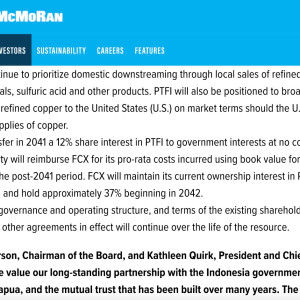
- The clause: Under the MOU, PT Freeport Indonesia is positioned to "broaden its marketing of refined copper to the United States... should the U.S. require additional supplies."
- Strategic flexibility: Though framed in commercial terms, the clause effectively creates strategic flexibility. During periods of heightened geopolitical tension or defense demand, copper cathodes refined in Indonesia can be prioritized for U.S. buyers rather than competing on the open global market.

Image source: FCX Announces Agreement for Life of Resource Extension of Operating Rights in Grasberg Minerals District[1] Strategic value of copper for the United States The Grasberg extension serves as the physical foundation for Project Vault, the massive £12 billion strategic mineral reserve initiative launched by the Trump administration on February 2, 2026.
The project aims to build a domestic buffer for 60 minerals, with copper, the second-most utilized material for U.S. national security, at the top of the list. As a U.S.-based giant (Phoenix, AZ), Freeport allows the U.S. Department of Defense (DoD) to "lock in" long term reserves under the control of an American operator, ensuring high-purity copper cathodes are never rerouted to geopolitical rivals.
Fuelling the War Machine Copper is the "blood" of modern military tech. The Pentagon's demand is transparent and massive:
- F-35 fighter jets: Each jet requires roughly 8,000 lbs of high conductivity copper for its complex avionics and wiring.
- Virginia-class Submarines: These silent giants use nearly 1,000,000 lbs of copper for electrical and propulsion systems.
- Missile Systems: Copper is the primary material for the shaped-charge liners in advanced anti-tank and anti-ship munitions.
The Grasberg extension aligns with broader U.S. efforts to secure reliable long-term access to critical minerals.
As a U.S.-based company headquartered in Phoenix, Arizona, Freeport provides operational continuity under an American corporate structure, reducing exposure to supply disruptions in more volatile jurisdictions. What's for Indonesia? In exchange for this strategic alignment, Indonesia is securing specific domestic deals:
- Equity transfer: Indonesia is getting an additional 12% stake in 2041, bringing total Indonesian ownership to ~63%.
- The smelter priority: The deal ensures copper is processed in Indonesia first (hilirisasi), meaning the U.S. will buy refined copper cathodes rather than raw ore.
Critics: Not a win-win deal
Despite the government's promises of economic gain, several observers have issued sharp criticisms. Fahmy Radhi, an Energy Economics Observer from Gadjah Mada University (UGM), stated that granting operating rights based on the "life of reserves" is a blunder that strips Indonesia of its bargaining power. "We have lost the momentum for renegotiation forever because control has been locked in until the reserves are exhausted," he emphasized. Mining law expert Ahmad Redi highlighted potential constitutional violations within this "life of mine" scheme.
Redi argued that the concept of granting permits based on the lifespan of reserves obscures state sovereignty over natural resources. "Article 33 of the 1945 Constitution mandates absolute state control. By locking in permits for the life of the mine without clear periodic timeframes, the state de facto relinquishes its right of control and the function of periodic evaluation over foreign companies," he explained. He also stressed that this policy risks creating a dangerous precedent where strategic resources are pawned off for the defense interests of another nation under the guise of investment certainty.
Meanwhile, Melky Nahar from JATAM (Mining Advocacy Network) assessed that this agreement sacrifices sovereignty for the sake of foreign military interests. "Indonesia is merely becoming a servant to U.S. defense interests (Project Vault) under the pretext of investment, while the long-term environmental impact in Papua remains a burden for the local people," he stated.