Moving from airfreight to road?
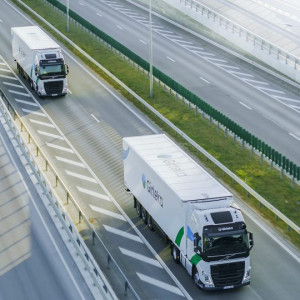

Disruptions to airfreight corridors caused by the crisis sparked off this month in the Middle East are encouraging shippers and forwarders to explore the potential for China - Europe road transport - so said Beata Uziene, head of intercontinental solutions at Girteka, the Vilnius, Lithuania-headquartered road cargo transport specialist. For those moving time-sensitive freight, the fact that several major air corridors linking Asia and Europe are no longer operational and that cargo flying on those routes is having to be rerouted onto longer flight paths is a particular problem. But for any companies relying on predictable delivery schedules, the latest crisis in the region is increasing transit times and creating volatility in airfreight capacity availability, Uziene pointed out.
As a result, logistics providers are reporting increased interest in long-distance road cargo transport between China and Europe, a corridor that has gradually matured in recent years as an alternative to both rail and sea freight, Uziene continued. "Disruptions to major air corridors between Asia and Europe are already forcing shippers to reassess their transport options," Uziene said. ""In situations like this, companies start looking for solutions that offer both speed and predictability.
Long-distance road transport between China and Europe can provide exactly that." Driving change "Road transport via Central Asia offers door-to-door transit times of roughly 14 to 18 days between China and Europe," Uziene explained.
"It sits between airfreight and rail in terms of speed, but with much greater flexibility because the cargo remains on the same transport unit throughout the journey." The corridor connects major Chinese production hubs - including Shenzhen, Shanghai, Beijing, Qingdao and Chengdu - with key European markets such as Germany, France, the Benelux region, Italy, Spain, the UK and Poland, typically crossing Central Asia before entering the EU. In addition to China, some logistics providers are also extending these road corridors to manufacturing hubs in Vietnam and Cambodia, linking Southeast Asia with European markets via Central Asia.
"When air cargo corridors become uncertain, supply chains start rediscovering the value of road transport between Asia and Europe," Uziene suggested.
Airfreight will remain essential for the fastest shipments, but the current disruptions highlight the importance of modal flexibility and diversified transport corridors in global supply chains.