Honda’s first full electric motorcycle is faster than a Hornet and comes in a CBT-compliant version for L-platers
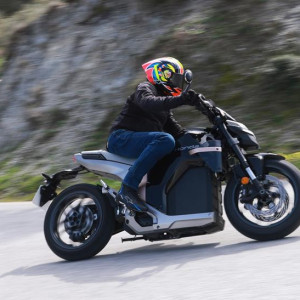
Honda WN7 review summary
4 out of 5 (4/5) Whooshing along at speed in a cocoon of calm and quietness is an experience like no other if you've never ridden an electric bike[1] before. It isn't better than a machine with an internal combustion engine, but it isn't worse either - it's just different.
The ?12,999 WN7, available in dealers in June, is Honda's first ever big electric bike, but it's arrived at a time when riders aren't exactly falling over themselves to go battery power. So, the big question is why?

Like this story? You can get more MCN in your life by clicking here and asking Google to make us a preferred source[2].
Honda have been making electric moped and 125cc equivalent scooters for years, as well as cars. They see electric vehicles (EVs) as very much a part of their future, although not exclusively. There's still an appetite to make Fireblades[3], Africa Twins[4], Goldwings[5] and everything in between, but they want to expand their electric two-wheel range, learn from it and create halo EV machines for riders to aspire to.
So just how many will flock to their local Honda[6] dealer to grab a peek at a WN7? Time will tell.

Is the Honda WN7 right for you?
Reasons to buy:
+ Smooth and powerful motor
+ Finish quality is excellent
+ Can be fast-charged for quicker battery recharge Reasons to avoid:
- 87-mile range isn't suitable for everyone
- Hard seat and no wind protection with zero optional accessories addressing these areas
- ?12,999 is a lot compared to more affordable, more practical, and better equipped combustion alternatives
Familiar elec-trickery
In terms of cutting-edge tech, the WN7 isn't too different from the current competition, but its high-voltage battery allows uses of the DC fast-charging network, which puts it ahead of the pack.
Not only can you top your battery up in the time it takes to grab a service station coffee... and pick yourself up off the floor at the price of it, but chargers are plentiful and in secure environments. So no more standing with your bike next to a slow charger in an abandoned car park questioning your life choices, although the Honda is compatible with those machines. You can plug it in at home and charge overnight with a supplied cable and three-pin plug.

Like all Hondas, the letters and digits in its name have a meaning.
The 'W' signifies the wind, 'N' for naked and the '7' is how far up the scale of their electric bikes the WN7 sit. The EM1e[7] and CUVe[8] scooters are at the bottom, which could imply that we might see even more powerful Honda EVs in the future. But where the WN7 really separates itself from the competition is it's... a Honda.
The engineers who've developed it, headed by Masatsugu Tanaka have worked on projects as diverse as the CBR600RR[9], Transalp[10] and factory RC213V MotoGP bikes.
They know exactly what a motorcycle should feel like, from the way it goes, stops and handles, to how it's supposed to be screwed together. They're all whippersnappers, too with an average age of 35.

...but it's a Honda
Up-close build quality is superb. The WN7 is smaller and more compact than it looks in pictures - almost the same dimensions as the CB750 Hornet[11], with paint finishes and attention to detail that have more than a whiff of HRC to them.
Much of the metalwork on display is aluminium, not steel and sporty touches include a single-sided swingarm, upside-down forks, Pirelli Diablo Rosso III tyres and Nissin brakes, which are packed with an astonishing level of feel for a road bike.

It has traction control, cornering ABS, a crisp colour display, a speed limiter (so no more unintentionally edging over 20mph limits), four regen settings, reverse, a walking speed mode and keyless ignition. The battery and motor housing form the chassis, so there's no frame, which is a Honda first. It is a weldless, bolted-together, weight-centralised structure built with the same flex and stiffness qualities as any conventional chassis for cornering feel and stability on the power and brakes.
It comes in three colours: black, grey and a Duracell-esque black and gold.

Smooth operator
Where petrol engines have their own distinct character depending on the number of cylinders, balance shafts, firing order and everything in between, an electric motor is an electric motor. All battery bikes basically feel the same when you open their twist-and-go throttles. They deliver instant torque and lots of it, linear power and zero vibes.
The WN7 is no different, but it's also worth mentioning that it goes like stink. Acceleration may not be superbike[12]-worrying, but the way it hits its top speed of around 80mph with no breaks to change gear is relentless, stomach-churning and makes you feel slightly queasy.

The 15bhp A1 restricted licence version makes the same torque and will bludgeon you with similar initial acceleration but fizzles out earlier. Hang on to your L-plates.
Not only is the Honda fast, but the throttle is smooth in each of its four riding modes, making it easy to ride in the towns and open roads we sampled here at Honda's Malaga world launch. Its four-way adjustable regen system, operated via finger and thumb switchgear paddles, does more than just push charge back into the battery. Since there's no gearbox, you can also use more regen to mimic a downshift, for when you need extra braking on the way into a corner, or navigating tight downhill turns.

A class act
But what makes it a Honda is how complete everything feels and there's none of the clattering you can hear from the running gear on a lot of electric bikes[13], with no engine vibration or sound to cover up the noise.
The WN7 is tight and quiet thanks to a silent belt drive and helical-cut gearbox cogs, like a Goldwing[14]'s, to help it whisper along.

Its ride is supple and its poise and balance through corners lets you carry big speed with lean, which is a lot of fun. It carries its 217kg well and is surprisingly agile thanks to a relatively skinny, but still grippy, 150-section rear tyre. Honda have made the WN7 very slim and barely wider than the forks, so it's easy to manage around town.
There will never be any engine heat to roast you on a hot day, although the standard five-way adjustable heated grips on full whack would warm a three-bedroom semi on a winter's day. Its motocross-style seat is pretty hard, but with an average 87-mile battery range you're never going to be on-board for long for it to be a problem.

As far as hitting its design brief, the WN7 is bang on and does everything it's supposed to do for an EV, with a few niggles. The bar-end mirrors (another Honda first) give as much view of your elbows as behind and it could do with a scooter-style handbrake to stop it rolling back on a hill.
What it doesn't do is what we already know about electric. There's no visceral roar or rumble from within, no clutch to slip or gears to snick. Range is limited and even with its fast charging capability, its lifeblood still isn't as easy to administer as a couple of glugs of petrol anytime, anywhere.
But that's a whole different EV vs internal combustion engine conversation.

There's nothing about the WN7 that will make you rush out and give up your petrol bike. That's fine with Honda and they're not twisting anyone's arm, but EV interest in general is gathering momentum worldwide, even if it's not the only solution (it would be interesting to see the take-up if they offered a period of free charging, like Tesla have with some of their models). Honda are just giving us choice, and for commuter and weekend warriors who want to go the EV route, the WN7 won't disappoint.

TECH SPOTLIGHT
Other than being Honda's first electric 'big bike', there's nothing too groundbreaking about the WN7's tech, or anything we haven't seen before from the likes of Livewire[15], Zero[16] and the sadly defunct Energica[17].
It uses a liquid-cooled electric motor to push it along, which makes a maximum of 67bhp, or 24bhp 'continuous', which is the amount of power it can happily make all day without doing itself a mischief. A1 versions will make 15bhp. Giving the motor its juice is an air-cooled lithium-ion 349.44V battery housed inside a cast aluminium case that doubles up as the Honda's monocoque chassis.

There are three ways to charge: at home with a normal three-pin plug, which will take around 5.5 hours from zero to full, or with a dedicated wall-mounted 6kVA home charger it will take just 2.4 hours.
But where the WN7 scores against its rivals is it's compatible with DC CCS2 fast charging.
That means you can rock up at one of an ever-expanding network of fast chargers to zap the battery from 20% to 80% in 30 minutes, which will give you an extra 55-mile range (or 60 miles for the A2 version).

You also get four levels of 'regen' operated via finger and thumb paddles on the left switchgear, where rolling off the throttle and the subsequent 'engine braking' recharges the battery. Claimed average range is 87 miles. Honda claims 0-31mph in 3.9 seconds, 0-62mph in 4.6 seconds (faster than a CB500 Hornet) and a top speed of 80mph, or continuous 70mph.
MCN Verdict
'Honda's first big electric is a success'
It shouldn't come as a surprise that Honda's first stab at producing a big electric bike would be a success. They've a huge amount of car and scooter EV experience behind them and the technical know-how that's helped create some of the best road and racing motorcycles ever made. The WN7's ability to use the fast-charging network is a huge bonus and removes some of the barriers to going electric and, like all battery bikes, it's smooth, quiet and accelerates to motorway speeds before you've had time to catch your breath.

But where it differs from the competition is the way everything works so well together, from the way it carves through fast corners to the power of its brakes and the way it's bolted so beautifully together.
The WN7 isn't meant to drag you away from your petrol bike, but instead offers a credible, perfectly executed electric alternative for those who want it.
References
- ^ electric bike (www.motorcyclenews.com)
- ^ clicking here and asking Google to make us a preferred source (eur01.safelinks.protection.outlook.com)
- ^ Fireblades (www.motorcyclenews.com)
- ^ Africa Twins (www.motorcyclenews.com)
- ^ Goldwings (www.motorcyclenews.com)
- ^ Honda (www.motorcyclenews.com)
- ^ EM1e (www.motorcyclenews.com)
- ^ CUVe (www.motorcyclenews.com)
- ^ CBR600RR (www.motorcyclenews.com)
- ^ Transalp (www.motorcyclenews.com)
- ^ CB750 Hornet (www.motorcyclenews.com)
- ^ superbike (www.motorcyclenews.com)
- ^ electric bikes (www.motorcyclenews.com)
- ^ Goldwing (www.motorcyclenews.com)
- ^ Livewire (www.motorcyclenews.com)
- ^ Zero (www.motorcyclenews.com)
- ^ Energica (www.motorcyclenews.com)