Hay fever tablets, flip flops and ice creams could land drivers in trouble

With the clocks going forward on 30 March and longer evenings returning, many UK drivers welcome the end of winter driving. Research shows that 45% of motorists feel less confident driving in darker evenings, and more than 10 million motorists avoid driving at night altogether during winter. However, the brighter months also bring unexpected risks.
Sun glare contributes to around 25-36 fatal accidents in the UK each year, and insurance experts at Zego warn that everyday habits - such as taking hay fever tablets, wearing flip flops, or eating ice creams while driving - can lead to fines that many drivers don't realise exist.
- Your hay fever tablets could get you a drug driving charge
Drug-driving laws apply to both illegal substances and some over-the-counter medications. If an antihistamine impairs your driving and police stop you, the penalties are the same as drug driving: a minimum one-year ban, an unlimited fine, up to six months in prison, and a criminal record that stays on your licence for 11 years. Ingredients such as chlorphenamine, diphenhydramine and promethazine can cause drowsiness.
Drivers who need to be on the road should consider non-drowsy options like loratadine or cetirizine and always check the label first.
- You could be fined for eating an ice cream while driving
There's no specific law banning eating while driving, but it can still lead to penalties if it distracts you. Under Highway Code Rule 148 and the Road Traffic Act 1988, police can issue a careless driving charge carrying a GBP100 fine and three penalty points. If the case goes to court, particularly if eating contributed to an incident, penalties can rise to GBP5,000, nine points, and a potential driving ban.
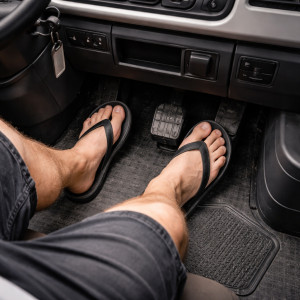
- Flip flops behind the wheel could cost you GBP5,000
Highway Code Rule 97 states drivers must wear footwear that allows them to use the controls properly.
Flip-flops can slip off pedals, get caught under them, or reduce braking force. If police believe footwear contributed to unsafe driving, penalties start at GBP100 and three points but can rise to GBP5,000, nine points, and a possible driving ban. Approximately one in three British drivers believes flip-flops are already explicitly prohibited on the road. They are not, but the legal exposure of wearing them is real regardless.
- Blasting music with your windows down could get your car seized
Highway Code Rule 148 requires drivers to avoid distractions that could stop them from hearing emergency vehicle sirens.
Loud music with the windows down can create exactly that situation, particularly at higher speeds when wind noise increases. Excessive vehicle noise can also breach construction and use regulations. If music is deemed too loud, police can issue a noise abatement notice and may seize the vehicle if drivers fail to comply. Research suggests that at 60mph, wind noise through open windows can reach levels that make external sounds, including sirens, genuinely difficult to detect.
- Leaving your sunglasses on after dark could land you a GBP2,500 fine
The legal requirement for adequate visibility while driving is well understood.
What is less well known is that the law is indifferent to the cause of any reduction in that visibility. Wearing tinted lenses after sunset, in tunnels, or in any low-light condition where they impair vision below the required standard can result in a careless driving charge carrying a fine of up to GBP2,500. It is rarely a deliberate choice, sunglasses go on in the morning and, during long summer evenings when light fades gradually, are simply never taken off.
That absent-mindedness is precisely what makes this such a common seasonal trap.
- A cracked or dirty windscreen could land you in serious trouble, especially in summer
Sun glare through a cracked, chipped, or dirty windscreen can dramatically reduce visibility, reaction times, and stopping distances. Driving in this condition may be classed as improper control of a vehicle under UK law. Around 3.7 million UK drivers are estimated to be driving with windscreen damage that affects visibility, often becoming obvious when bright spring sunlight returns.
- Using your phone as a sat nav without a proper mount
The offence applies whether the phone is being held, glanced at, or simply propped against a cupholder in the driver's eyeline.
A phone that is not fixed in a secure, purpose-built mount does not meet the legal requirement for hands-free use. The penalty is GBP200 and six points, sufficient to revoke a newly qualified driver's licence in a single incident. Mobile phone use contributes to approximately 500 casualties on UK roads every year, a figure widely considered an underestimate given the difficulty of detection.7 Unfamiliar routes during summer travel are when drivers are most likely to rely on informal phone positioning. It is also when they are most likely to be stopped.
- Your number plate could be an instant GBP1,000 fine
Under the Road Vehicles Regulations 2001, any number plate obscured by mud, dirt, or accumulated road grime, regardless of how it got there, carries a fixed GBP1,000 penalty.
Spring is the most common season for this offence. Vehicles that have not been thoroughly cleaned since autumn carry months of road spray into the first sunny weekends of the year, and the fine arrives without warning and without any other incident to prompt it. Spokesperson at Zego comments:
"Every summer we see the same patterns in claims and incidents, and a lot of them come down to habits people don't even think of as risky.
Eating a snack on a long drive, popping your usual allergy tablet, kicking your shoes off when it's warm; these are things people do every single day without a second thought.
The law sees it very differently, and the fines are serious enough to put a real dent in anyone's summer."