Brighton & Hove Buses 10-year Partnership with Guide Dogs
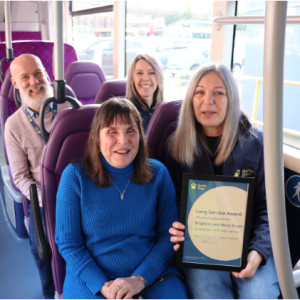

Brighton & Hove Buses recently celebrated ten years of partnering with the charity Guide Dogs to provide sighted guiding training for staff. The teams gathered in Brighton alongside a local guide dog owner to mark the occasion. Guide Dogs' specialist sighted guide training helps teach the skills and confidence needed to safely guide people with sight loss. The sessions also help raise awareness of the impact of sight loss and the legal access rights of guide dog owners, as part of the charity's mission to make spaces more inclusive and accessible for all.
Brighton & Hove's fleet of 222 buses serve the local area, as well as Crowborough, Eastbourne, Lewes and Tunbridge Wells. Together with its sister company, Metrobus, Brighton & Hove Buses helped passengers across these regions make 64 million journeys last year. In the city of Brighton & Hove alone, these passengers made more journeys per capita than anywhere else in the UK outside of London. At Brighton & Hove Buses, over 2,000 employees have completed sighted guide training since Guide Dogs delivered the first session in 2014. Since 2016, the bus operator has run these sessions for staff as one of Guide Dogs' official Training Delivery Partners.
This involves working closely with the charity to ensure all staff are taught best practice methods and materials for guiding people with sight loss. Sighted guide training is now a mandatory part of onboarding for employees joining Brighton & Hove Buses. This means that all new staff can learn how to guide people with sight loss in a safe and empathetic way, giving drivers and wider team members the confidence to offer assistance, and techniques to guide passengers if needed. To celebrate their ten-year partnership and progress towards making bus travel more accessible, staff from Brighton & Hove Buses, Metrobus and Guide Dogs came together in Brighton alongside local guide dog owner, Alison Evans MBE, and her guide dog, Matty.
Nicola Schwarz, a Sighted Guide Training Officer at Guide Dogs who attended the event, said: "We want to make all spaces welcoming and inclusive for people with sight loss. This includes public transport, which people with a vision impairment often rely on to live independently. "By delivering sighted guiding training to all staff, Brighton & Hove Buses are helping open up the world even more for blind and partially sighted people, ensuring that passengers can get support whilst travelling around if they need it. "Staff who complete sighted guide training with Guide Dogs or our official partners, like Brighton & Hove Buses, learn how to safely guide someone through narrow spaces, up and down stairs, through doors, and to seats.
They also learn the importance of communication. Things like introducing yourself and describing the world around you can have a huge impact on someone's experience. "It's fantastic to see Brighton & Hove Buses' longstanding commitment to accessibility.
Our partnership is not only supporting passengers with sight loss but also helping to foster greater inclusion and understanding across communities in Sussex." The sighted guide training partnership has led to Brighton & Hove Buses collaborating with Guide Dogs on wider initiatives aimed at increasing accessibility. For example, feedback from the charity and local people with sight loss has also helped shape bus design, with hearing loop systems and audio-visual announcements put in place across Brighton & Hove Buses' entire fleet. This is ahead of new legislation which will require all buses in the UK to have visual analysis from 1st October 2026, thanks to campaigning by Guide Dogs and others.
In addition, Guide Dogs has co-designed Brighton & Hove Buses' award-winning Helping Hand card. This enables passengers across Sussex - including people with sight loss and other invisible disabilities - to discreetly request assistance from staff. Gordon Frost, Operations Director at Brighton & Hove Buses, said: "We're proud to mark ten years as a Training Delivery Partner with Guide Dogs.
More than 2,000 of our drivers have completed sighted guide training, helping ensure blind and partially sighted passengers feel confident and supported when travelling with us. Accessibility remains central to everything we do, and we're grateful to Guide Dogs for their ongoing expertise and partnership." Guide Dogs offers sighted guide training to communities, businesses, and friends and family of people with sight loss.
For more information visit: www.guidedogs.org.uk/how-you-can-help/sighted-guide-training.
Transport & Logistics Magazine - Driving The Industry Forward