ASU works with Freeport-McMoRan to strengthen supply of a critical mineral — copper
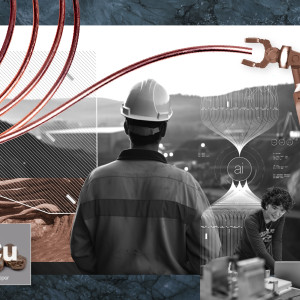

Copper is a key part of the Arizona economy -- and Arizonans' lives.
In elementary school, Arizonans learned that copper was one of the original 5 C's[1], the cornerstones of the state's early industry. Historically, Arizona copper has supported the nation's electrification and supplied national defense efforts during the world wars.
Today, this reddish metal is as important as ever. In 2024, the Arizona Mining Association recorded that the copper industry added more than £21 billion total impact and around 60,000 jobs in Arizona -- the second largest employment sector after semiconductors, which use copper.
Even if your job doesn't relate to copper, almost every aspect of daily life does.
The average home contains more than 400 pounds of copper, from electrical wiring to plumbing to appliances. Consumer electronics, the energy grid, national security, transportation systems and health care also all rely on copper.
Copper is so vital to American life that it was recently added to the U.S. critical minerals list[2]. As demand for domestic critical mineral supplies grows, so does the need for better mining techniques and a workforce ready to secure these materials.
Freeport continues to be among the industry leaders developing innovative techniques to safely, sustainably and efficiently mine copper.
Brian EtheridgeDirector of general and administrative business architecture, Freeport-McMoRan
In support of this goal, Arizona State University collaborates with Freeport-McMoRan[3], a leading international metals company headquartered in Phoenix that focuses on copper mining and processing. The company's mining operations and business activities generated £4.6 billion in economic benefits for Arizona and employed more than 11,000 people in the state in 2024.
"Freeport continues to be among the industry leaders developing innovative techniques to safely, sustainably and efficiently mine copper," says Brian Etheridge, director of general and administrative business architecture at Freeport. "As the world continues to electrify, how we approach everything from attracting and retaining talent to processing ore bodies requires us to reimagine mining to meet the growing demand for copper.
"We are excited to partner with ASU both to create new technology to improve processing, and to equip our team with the skills necessary for the future of mining, building careers and growth opportunities. ASU's depth across multiple disciplines critical to the mining industry cement them as a valuable partner in our efforts."
New technologies to advance mining efficiency
Copper doesn't come out of the ground ready to use as metal. Instead, it is mostly found fused with other elements like iron and sulfur in rocks. When those rocks contain enough copper in them, they are known as ore.
But this ore still contains a lot of unwanted material that needs to be separated out. In addition, not all ores that contain copper are the same, so they require different processing methods.
Once copper ore is removed from the earth, mining companies like Freeport need to know what it contains to better prepare it for processing. This is one of the first steps of turning raw minerals into the pure metal we're familiar with when we think of copper.
The sooner and more precisely mine operators can analyze a sample's mineral composition, the more sustainable the process can be -- reducing waste, energy and chemical use, and lowering costs.
ASU researchers are helping Freeport improve this process in a new project.
The research team will develop an automated system -- a combination of sensors, robotics and artificial intelligence -- that classifies materials faster and more precisely than current methods.
One challenge the researchers need to overcome is finding sensors that can handle the task. The work must be done in harsh, fast-moving conditions, and existing sensors aren't designed to analyze dusty, irregularly sized rocks rushing out of a mine at multiple tons per minute.
Yuri Korobeinikov[4], a metals expert and assistant research professor in the School for Engineering of Matter, Transport and Energy[5], part of the Ira A. Fulton Schools of Engineering[6] at ASU, will lead the team's efforts to find a suitable system of sensors.
Learn more about critical minerals research
This is one of many ASU research initiatives related to critical minerals, including several in partnership with Freeport-McMoRan. Read more about some of ASU's critical minerals innovations[7].
"We are designing a system that can analyze the chemical composition of rock in real conditions, not only in the lab," Korobeinikov says. "We will test different sensing systems on real rock, from multiple angles and speeds in a simulated dusty environment, and compare those readings with precisely tested lab samples and sensors to ensure our system is accurate."
Then the team will add in smart robotics and AI to improve precision and quality.
Robotic handlers can position samples so the sensors can do their work, while machine learning increases the usefulness of sensor data.
"Smart robots combined with intelligent algorithms are opening new avenues for the use of robots in mining operations," says Binil Starly[8], a professor of manufacturing engineering and director of the School of Manufacturing Systems and Networks[9], part of the Fulton Schools.
A planned demonstration will show how the system could work on mining conveyor belts to classify minerals at real-time speeds and at the scale large mines need.
The research partnership between Freeport and ASU underscores the value of collaboration between industry and academia, says Wenlong Zhang[10], an associate professor of manufacturing engineering and the research director at the School of Manufacturing Systems and Networks who will work with Starly to integrate the robotics and AI.
"It will not only generate novel and practical solutions to material classification problems for this industry," Zhang says, "but also develop testbeds and talent pipelines for Arizona to stay in a leading position as robotics, sensors and AI revolutionize the day-to-day operations of the mining and critical minerals sector."
Nonfuel minerals are essential to the U.S. economy, and Arizona is among the top three states producing them, according to data from the U.S. Geological Survey[11]. The category of materials includes many of the 60 U.S. critical minerals and others, from crushed stone to gold, which are necessary for American industries such as construction, electronics and aerospace.U.S. copper and molybdenum production -- both mined in Arizona -- are each worth more than £1 billion. Graphic by Andy Keena/ASU (with data from USGS)
Investing in people to boost performance
Technology is only part of staying competitive in mining.The industry's success also depends on its workforce. To strengthen retention and training, Freeport turned to the W. P.
Carey School of Business[12], building on its long-standing research partnership with ASU. Together, they developed a 12-month plan to refine onboarding. "There are significant efficiencies and competitive advantages to be gained from looking at your human resource processes and practices," says Eric Knott[13], an associate teaching professor in the W.
P. Carey School of Business Department of Management and Entrepreneurship[14] as well as founder and CEO of the human resources consulting firm FinePoint HR[15].
"Turning over employees is expensive," says Knott, who leads the hiring and onboarding initiative with Freeport. "That's money that could be reinvested in Arizona communities."
The initiative's pilot focuses on mining operations and maintenance teams in Arizona's Bagdad[16] and Morenci[17] "company town" mining communities. These mines have been in operation for around 100 years.
As of 2024, the two mines employ more than 5,000 local people combined. Bagdad contributed £196 million in economic benefits to Yavapai County that year, while Greenlee County received £339 million from Morenci operations.
The first step of the initiative was strengthening new-employee orientation. The start of a new job is critical to whether new hires feel connected and committed, especially when they are weighing other offers.
"Freeport has an absolutely incredible culture and a world-class work environment.
We definitely want to make sure the new hire continues to feel recruited as they are going through orientation and onboarding, continuing to remind the new hire why they chose Freeport and the incredible opportunity that's ahead of them," Knott says.
ASU's recommendations have focused on updating the less engaging aspects of orientation. For example, the ASU team proposed swapping slide-deck lectures for more interactive methods.
Their guidance is also aimed at keeping new hires from feeling overwhelmed. An employee's first few days, also called the nesting period, usually involve taking in mountains of new information all at once.
Introducing onboarding content in controlled stages over time could help.
Next, the team is focused on increasing engagement through the first year of employment. They are also creating a mentoring program to further cultivate high-performing teams.
"New hires want a buddy, a mentor," Knott says. "They want someone to give them feedback and perspective outside of their designated leader. Peer mentors are an absolutely excellent way to keep new employees engaged and to grow the leadership skills of the mentors.
This will add retention and productivity to the new employees and will add to the leadership bench strength of Freeport -- a win-win!"
The project's recommendations will be evaluated through 2026, with implementation planned for 2027. Freeport would recoup its investment by retaining roughly 10 additional employees. Beyond retention, more engaged teams can lower retraining costs, improve workplace safety, reduce attendance issues and boost productivity.
For employees, it means better support and stronger career paths in stable, well-paid jobs that sustain rural mining communities.
Industry insights further prepare critical minerals workforce
The partnership with Freeport helps ASU further align its research and coursework -- particularly in the Ira A. Fulton Schools of Engineering and the School of Earth and Space Exploration[18] -- with the technologies and skills needed as the mining industry evolves.
"The partnership with Freeport helps ASU researchers understand the current industry practice, identify challenges and areas of improvement, and define specific processes and minerals that are of great importance for the industry," Zhang says. "We are also discussing with Freeport about possibly developing a testbed on ASU campus, which allows many ASU students to apply their knowledge into this critical area of research and prepare them for a successful career in the mining industry."
Many different roles contribute to mining and mineral exploration, from geologists to lab analysts to data scientists and more. ASU students are already developing in-demand skills for these roles.
The collaborative relationship with Freeport gives the ASU faculty a firsthand look at Freeport's operations, helping expand relevant learning opportunities for students.
In one example, geology faculty members from the School of Earth and Space Exploration recently visited Freeport's Core Logging Facility in Tucson to see industry science in action. There, the company uses geologic expertise and advanced technology to analyze drill cores, which are cylindrical samples of deeply buried rock obtained by drilling into the crust at sites across Arizona and New Mexico.
These samples are the foundation to understanding the distribution of minerals beneath the surface and planning future mining work.
Since the visit, the professors are discussing ways to better integrate their teaching and research with Freeport's work. They see the partnership leading to hands-on activities with actual drill core samples, applied learning projects and case studies based on real data, opportunities for students to visit mines and talk to industry professionals, and more.
All of these opportunities will better prepare ASU students for careers in the minerals industry, which is a mainstay of Arizona's economy.
"The School of Earth and Space Exploration has a vibrant and nationally respected academic program in geological sciences that prepares our graduates through a combination of field, laboratory and classroom study in subjects directly relevant to the critical minerals industry," says Steven Semken[19], President's Professor of geology and education in the School of Earth and Space Exploration and one of the faculty members who visited the Core Logging Facility.
"This partnership between ASU and an Arizona-based global mining company will benefit both parties," he says. "Working directly with Freeport helps us rethink what we teach and how we teach it.
Ongoing opportunities to engage with Freeport ensures our graduates are competitive and ready to contribute to modern copper and other critical-minerals operations in Arizona and beyond."
Working together on critical minerals challenges
The near-term need for additional critical minerals resources presents many complex challenges, including finding minerals, sustainably extracting them and building the domestic workforce. No one company or institution can address these alone.
The path to progress is built on coordinating industry needs, research and public priorities.
ASU brings companies and communities together with the resources required to create practical solutions to shared problems. Its partnership with Freeport-McMoRan reflects a long-term, trust-based approach built on transparency and collaboration rather than one-size-fits-all answers.
"ASU works with corporate partners the way complex problems demand: by listening first, co-designing solutions and delivering results at scale," says Grace O'Sullivan[20], the vice president of Taiwan Semiconductor Manufacturing Company Partnership Initiatives in the ASU Office of University Affairs[21] who previously served as vice president of Corporate Engagement and Strategic Partnerships[22] at ASU. "Together, we align research and workforce development with industry needs in ways that create value not only for partners, but for the communities those innovations impact."
Industry partnerships also create applied research opportunities that drive innovation in a competitive sector. They prepare a skilled workforce by creating and sustaining jobs that are critical to the state's economy.
And they position Arizona as a hub for advanced manufacturing and critical minerals that attracts investment across the supply chain.
This research was funded in part by Freeport-McMoRan.
References
- ^ 5 C's (azsos.libguides.com)
- ^ U.S. critical minerals list (news.asu.edu)
- ^ Freeport-McMoRan (www.fcx.com)
- ^ Yuri Korobeinikov (search.asu.edu)
- ^ School for Engineering of Matter, Transport and Energy (semte.engineering.asu.edu)
- ^ Ira A. Fulton Schools of Engineering (engineering.asu.edu)
- ^ Read more about some of ASU's critical minerals innovations (news.asu.edu)
- ^ Binil Starly (search.asu.edu)
- ^ School of Manufacturing Systems and Networks (msn.engineering.asu.edu)
- ^ Wenlong Zhang (search.asu.edu)
- ^ according to data from the U.S. Geological Survey (www.usgs.gov)
- ^ W.
P.
Carey School of Business
(wpcarey.asu.edu) - ^ Eric Knott (search.asu.edu)
- ^ Department of Management and Entrepreneurship (wpcarey.asu.edu)
- ^ FinePoint HR (www.finepointhr.com)
- ^ Bagdad (www.fcx.com)
- ^ Morenci (www.fcx.com)
- ^ School of Earth and Space Exploration (sese.asu.edu)
- ^ Steven Semken (search.asu.edu)
- ^ Grace O'Sullivan (search.asu.edu)
- ^ Office of University Affairs (universityaffairs.asu.edu)
- ^ Corporate Engagement and Strategic Partnerships (corporate.asu.edu)