The Right to Protest Under Attack in the United Kingdom
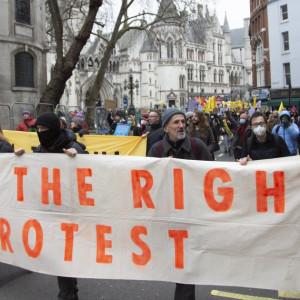

Recent legislative measures and resulting actions by the authorities in the United Kingdom (UK) have significantly constrained the right to protest. These legal restrictions and actions undermine the right to freedom of expression and peaceful assembly. By granting broad discretionary powers to police and criminalizing peaceful protest tactics, the UK state risks silencing dissenting voices, discouraging civic participation, eroding democratic accountability, and ultimately fraying the fabric of democracy itself.
While the UK government's obligation to ensure the right to peaceful assembly and freedom of expression is enshrined in both domestic and international legal frameworks--including the Human Rights Act 1998, the International Covenant on Civil and Political Rights (article 19 and 21) and the European Convention on Human Rights (articles 10 and 11)--legal developments have markedly expanded state powers to regulate and criminalize protest activity. These legislative changes, most notably through the Police, Crime, Sentencing and Courts Act 2022 (hereafter PCSCA 2022) and the Public Order Act 2023 (hereafter POA 2023), reflect a growing governmental emphasis on maintaining public order and safeguarding key infrastructure at the expense of civil liberties. The current government's ongoing failure to reverse abusive restrictions on protest introduced by its predecessor is compounded by its introduction of the Crime and Policing Bill 2025, before Parliament at time of writing, which proposes further restrictions on protest rights, and its decision to proscribe a pro-Palestine direct action group as a terrorist organization, a move criticized by United Nations (UN) human rights experts as endangering civil liberties by conflating protest with terrorism.
The shift in legal orientation and practice in relation to protest has been driven in part by successive UK governments' responses to disruptive protest tactics employed by environmental and social justice movements, such as Extinction Rebellion and Just Stop Oil. In doing so, the state has introduced vague and expansive legal thresholds, such as "serious disruption to the life of the community," which grant police broad discretion to intervene in and criminalize protest activities. These changes undermine democratic accountability and suppress dissent as they are open to broad interpretation, giving police and authorities wide latitude to decide what constitutes illegal protest, while also having a deterrent effect on protesters.
This report assesses the impact of the changes to protest legislation and examines their effects on the right to protest and how expanded police powers, criminalization of protest activities, and the jailing of protestors for acts that previously resulted in fines risks having a chilling effect on freedom of assembly. Human Rights Watch's research during 2024 and 2025 indicates that the new anti-protest legislation has resulted in arbitrary bans and undue restrictions on protests, arbitrary arrests, criminal charges for peaceful protest activities and an increasing number of custodial sentences. Human Rights Watch interviewed people organizing and participating in peaceful protests.
Protesters described a consistent pattern of confusion on the part of protesters and police, conflicting police instructions, and arbitrary arrests, even in cases where prior coordination with police had taken place. Protesters were detained for hours, had equipment seized, and in some cases were charged with public order offenses with little or no justification provided. Examples include the arrests of Republic activists during King Charles' coronation and the charges brought against activists for Palestinian rights on the basis of allegedly breaching vague protest conditions.
The criminalization of protests has resulted in harsher sentences, including prison sentences up to several years for non-violent actions like slow marching, planning protests, or bringing protest equipment. These are actions that in the past, in most cases, would have resulted only in fines or suspended sentences. In several high-profile cases, climate activists were convicted and sentenced to between two and five years in prison under the statutory offense of public nuisance for participating in online meetings planning direct action or staging peaceful stunts aimed at raising awareness.
On appeal, courts have at times acknowledged these sentences as "manifestly excessive," yet the chilling effect on dissent remains substantial. Government data shows hundreds of charges have been brought under new protest laws since 2022, in some cases for actions as minor as carrying placard straps or holding signs outside courtrooms. For example, Trudi Warner, a retired social worker, was charged with contempt of court simply for holding a sign about jurors' rights.
These developments underscore the increasing legal uncertainty and criminalization surrounding protest in the UK and raises serious concerns about the erosion of the right to peaceful assembly and expression. In May 2024, the High Court ruled that then-Home Secretary Suella Braverman acted unlawfully by introducing regulations that lowered the threshold for police intervention in protests from causing "serious disruption" to causing "more than minor" disruption. The Labour government elected in July 2024 decided to defend Braverman's regulations and appeal the High Court's ruling.
Following the government's appeal, the Court of Appeal in May 2025 upheld the High Court's ruling, confirming that the regulations were unlawful. Since the government failed to appeal the court decision, parts of the POA 2023 are legally void. The government should urgently review all arrests and convictions under the law.
The anti-protest laws have been the subject of both domestic and international criticism. In 2022, the UK Parliament Joint Human Rights Committee expressed serious concerns about the then-Public Order Bill (which had not yet been adopted), stating that expansion of stop and search powers, especially without reasonable suspicion, could result in potential misuse and the chilling effect on individuals' willingness to participate in protests. The committee stated that such provisions are disproportionate and inconsistent with the right to engage in peaceful protest and recommended their removal.
The UN High Commissioner for Human Rights and successive Council of Europe Human Rights Commissioners have criticized the UK anti-protest legislation, warning it could significantly restrict freedoms of expression, peaceful assembly, and association in violation of international human rights standards. Rather than change course in the face of such criticism, the government has doubled down with plans to introduce further restrictions on protest in the new Crime and Policing Bill 2025, currently pending before parliament. These include measures to impose a blanket ban on face masks at protests and to further restrict gatherings in the vicinity of places of worship.
While authorities have cited the attack on a synagogue in Manchester in October 2025 and attacks on mosques in 2024 and 2025 as context for the latter, existing criminal law provides sufficient powers to address both issues while respecting rights. Moreover, the proposals have drawn criticism from the UK Parliament's Joint Committee on Human Rights. Freedom of peaceful assembly is a cornerstone of democracy as it enables public participation, dissent, and accountability, all of which are essential elements to a functioning democratic society.
The UK also has an obligation under domestic and international law to protect the right of people to protest. The European Convention on Human Rights (ECHR) and the International Covenant on Civil and Political Rights (ICCPR)-both of which enshrine the right to peaceful assembly-are incorporated into domestic law via the Human Rights Act 1998. Those treaties provide that the UK not only has an obligation to tolerate peaceful protest, but also to facilitate and protect protest.
Any restrictions to protest must be narrowly drawn, pursue a legitimate aim, and be necessary and proportionate to that aim. Blanket bans on protests are disproportionate and unjustifiable. Unless the government repeals or adequately amends recent anti-protest legislation and scraps planned legislative changes that would further restrict protest, it will breach the UK's human rights obligations and pose an ongoing risk to the health of its democracy.
To the Government of the United Kingdom
-
Repeal or substantially amend protest-related provisions of the Police, Crime, Sentencing and Courts Act 2022 and the Public Order Act 2023 that unduly and disproportionately restrict peaceful protest. These include:
- Sections 73 and 74 of the Police, Crime, Sentencing and Courts Act 2022 allowing police to impose conditions on protests based on vague concepts like "serious annoyance," "serious unease," or "serious disruption."
- Sections 1 and 2 of the Public Order Act 2023 outlining criminal offenses targeting protest tactics such as "locking-on" or carrying items that might be used to do so.
- Sections 20-33 of the Public Order Act 2023 granting the UK courts powers to impose Serious Disruption Prevention Orders, particularly where these can be issued absent a criminal conviction.
-
Withdraw, delete, and/or remove the following current clauses of the Crime and Policing Bill 2025, pending before parliament:
-
Clause 118 of the Crime and Policing Bill 2025, which would criminalize the concealment of identity during protests. These provisions are overly broad, risk penalizing peaceful protesters for legitimate reasons (e.g. health, safety, privacy), and create a chilling effect on participation in lawful assemblies.
-
Clause 124, which would expand police powers to impose protest restrictions in the vicinity of places of worship.
Existing powers are sufficient to address threats to places of worship and the new measure risks being misused to suppress legitimate protest in public spaces. It must not be used to target particular groups or viewpoints, especially in light of recent responses to pro-Palestine protests.
- The proposed "cumulative disruption" amendment to section 13 of the Public Order Act, which would allow police to ban public processions based on aggregated disruption rather than the impact of the specific protest.
-
-
Stop the use of secondary legislation on matters pertaining to core democratic rights to ensure effective parliamentary scrutiny and debate.
-
Issue a standing invitation to the UN Special Rapporteurs on Freedom of Peaceful Assembly and Association, and on the Promotion and Protection of the Right to Freedom of Opinion and Expression.
-
Enact a statutory right to protest that sets out the negative and positive obligations of the State in relation to protest, as recommended by the UK Parliament Joint Committee on Human Rights.
-
Incorporate the International Covenant on Civil and Political Rights into UK domestic law, to strengthen the protection of the right to peaceful assembly.
-
Launch an independent review of the Metropolitan Police's conduct regarding the policing of protests. The review should make clear findings and recommendations including on best practice in terms of policing protests in a manner that protects and respects freedom of association, and assembly and freedom of expression.
To the Home Office
-
Prohibit the use of no-suspicion stop-and-search powers in protest contexts, which may disproportionately impact marginalized groups and risk discriminatory enforcement.
-
Ensure that police powers are used proportionately and with accountability, including by:
-
Publishing disaggregated data on protest-related arrests, stop-and-search operations, and charges brought under Police, Crime, Sentencing and Courts Act 2022 and the Public Order Act 2023.
-
Ensuring the police fully cooperate with the Independent Office for Police Conduct investigations into allegations of police abuse or misconduct at protests.
-
-
Ensure that post-legislative scrutiny of Police, Crime, Sentencing and Courts Act 2022 and the Public Order Act 2023 examines their impact on the right to protest, freedom of assembly, association, and expression under the Human Rights Act.
-
Reverse the proscription of Palestine Action as a terrorist group, and in the meantime issue guidance to police and prosecutors that peaceful protestors expressing opposition to the decision should not be arrested or charged.
To the Ministry of Justice/Director of Public Prosecutions
-
Review the application of Police, Crime, Sentencing and Courts Act 2022 and the Public Order Act 2023 to ensure that prosecutions and enforcement practices related to peaceful protest are consistent with the UK's human rights obligations and principles of proportionality.
-
Review all arrests, charges, and convictions made under the provisions quashed by the High Court's June 2025 ruling, publish the results of such a review, the action being taken pursuant to it, and a specific timeframe for both publication and action.
-
Collect and publish disaggregated data on protest-related prosecutions and sentences, including information on race, gender, age, and location.
To the UK Parliament Home Affairs Committee
-
Ensure that post-legislative scrutiny of Police, Crime, Sentencing and Courts Act 2022 and the Public Order Act 2023 examines their impact on the right to protest, freedom of assembly, association, and expression under the Human Rights Act.
To the UK Joint Committee on Human Rights
-
Conduct an inquiry on the state of protest rights in the UK.
This inquiry would build on the legislative scrutiny of the respective bills the committee has undertaken, and review, with the help of evidence, the impact of the legislation and policing under it on the right to protest and freedom of expression in the United Kingdom.
To the Sentencing Council
To United Nations Human Rights Bodies
-
Monitor the UK's compliance with its international obligations under the ICCPR particularly regarding freedom of expression and assembly.
-
Request detailed information from the UK government during its next Universal Periodic Review and up-coming treaty body reviews on the application and impact of anti-protest legislation.
-
Invoking the UK's standing invitation to the UN Special Procedures, Rapporteurs on the Rights to Freedom of Peaceful Assembly and of Association and on the Promotion and Protection of the Right to Freedom of Opinion and Expression, should request to undertake an official visit to the UK.
To the Council of Europe Commissioner on Human Rights
-
Monitor the implementation and effects of Police, Crime, Sentencing and Courts Act 2022 and the Public Order Act 2023and consider advisory or urgent opinions in response to pending or future cases.
A Human Rights Watch researcher carried out research in the United Kingdom between July 2024 and May 2025. The researcher interviewed 16 protesters, two lawyers, and representatives from civil liberties organizations Liberty and NetPol.
Interviews were conducted in person or over the phone. Interviewees were informed of the purpose of the interview. They were told that they could end the interview at any time or decline to answer any specific questions. No interviewee received compensation for providing information.
Human Rights Watch wrote to the Home Office, Ministry of Justice and the Crown Prosecution Service to request information and comment on the issues raised in this report. The Home Office and Crown Prosecution responded and their responses are reflected in the relevant sections of the report. At this writing, the Ministry of Justice had not responded.
Human Rights Watch also wrote to the London Metropolitan Police with detailed questions on policing protests under the new protest-related restrictions. At this writing, the Metropolitan Police had not responded.
In recent years, successive United Kingdom governments have enacted legislation and pursued policies that significantly restrict the right to freedom of assembly and peaceful protest--rights that are fundamental to any functioning democracy and protected under international law, including the European Convention on Human Rights. Two pieces of legislation introduced by the previous Conservative government--the Police, Crime, Sentencing and Courts Act 2022 (PCSCA) and the Public Order Act 2023 (POA)--represent a sweeping expansion of police powers and a sharp curtailment of civil liberties. Other measures that restrict protest--in particular the use of civil injunctions including those brought by private actors--also raise human rights concerns but fall outside the scope of this research project.
The PCSCA 2022 marked a major turning point. It granted police broad authority to impose conditions on public assemblies, including protests that are peaceful and nonviolent. Under this law, police officers may limit demonstrations on grounds as vague and subjective as causing "serious unease" or being "too noisy," and can penalize individuals who unknowingly breach such conditions.
These vague thresholds undermine the principle of legal certainty and shift the burden onto protesters to anticipate which acts are permissible and which must be avoided to remain within the law. The UK Joint Committee on Human Rights (JCHR) expressed serious concerns about Part 3 of the then PCSCA 2022 Bill, which covered "public order" offenses as it introduced new broadly defined powers that allow police to impose conditions on any protest, including one-person demonstrations, criminalizes minor breaches of these conditions, and expands "public nuisance" to potentially encompass peaceful protest enabling disproportionate penalties. The committee also raised concerns about access restrictions near Parliament and increased stop-and-search powers. The committee stressed that these measures could chill protest activity, restrict political dissent, and be applied in a discriminatory manner.
In July 2021, the then-Council of Europe Human Rights Commissioner Dunja Mijatovic urged UK Members of Parliament and peers to reject provisions in the Police, Crime, Sentencing and Courts Bill that could impose time and noise limits on protests. She warned that such measures might have a "significant impact" on freedom of expression and could be interpreted as attempts to "introduce restrictions on peaceful demonstrations." The Public Order Act 2023 went even further. It introduced a series of new criminal offenses targeting tactics commonly used in civil disobedience, including "locking on"--the act of attaching oneself to people, objects, or land to obstruct activities--and criminalized the possession of items with intent to do so. The act also penalizes disruption caused by tunnelling, obstructing major transport works, and interfering with key national infrastructure.
A particular concern in the POA 2023 is the introduction of Serious Disruption Prevention Orders (SDPOs). These enable courts, following requests by the police, to impose wide-ranging restrictions on individuals who have previously participated in protests deemed disruptive by police. The orders can be issued against an individual in the absence of a criminal conviction for public order offenses effectively allowing authorities to ban people from engaging in future protests based on past lawful conduct alone. As of this writing, no SDPOs have yet been issued, but their potential scope raises serious alarm for the protection of protest rights.
In May 2022, the JCHR also raised significant concerns about then-Public Order Bill--which had not yet been adopted--stating that expansion of stop and search powers, especially without reasonable suspicion, could result in potential misuse and a chilling effect on individuals' willingness to participate in protests. The committee stated that such provisions are disproportionate and inconsistent with the right to engage in peaceful protest. It recommended their removal. In an April 2023 statement, the UN Commissioner for Human Rights, Volker Turk said that the POA is incompatible with the UK's international human rights obligations regarding people's rights to freedom of expression, peaceful assembly, and association. Turk stated that the law imposes serious and excessive restrictions on protest rights that are unnecessary and disproportionate, and that they are "wholly unnecessary as UK police already have the powers to act against violent and disruptive demonstrations."
Civil society organizations, including Liberty, CIVICUS, and NetPol, have warned that these laws are vaguely drafted, excessively broad, and open to abuse, posing a serious threat to freedom of assembly and expression. The manner in which some of these provisions were introduced compounds the concern. In early 2023, the government used secondary legislation--bypassing full parliamentary scrutiny--to reintroduce protest-related measures such as stop and search without suspicion, SPDOs, and the broad definition of "serious disruption" despite their rejection by the House of Lords in January 2023 during debate on the Public Order Bill.
These powers had not been included in the PCSCA 2022, following earlier opposition. This procedural bypass undermined democratic accountability and highlighted an increasing trend of executive overreach. UK human rights organization Liberty brought a legal challenge to the government's attempt to sidestep parliament, and in May 2024, the High Court ruled that the government had acted unlawfully, stating that then-Home Secretary Suella Braverman exceeded her authority by enacting these regulations without proper legislative scrutiny. The previous government announced its intention to appeal the ruling in May 2024, and the incoming Labour government chose to proceed with the appeal instead of dropping it and accepting the ruling. The Court of Appeal in May 2025 upheld the High Court's ruling. In a welcome move, the government did not appeal the Court of Appeal decision.
As a result, parts of the POA 2023 are legally void, including sections that relied on the lower threshold of public disruption as "more than minor," as opposed to the previous threshold of "serious"; the offenses of locking on and going equipped to lock on and stop, as well as sections that give police power to search without suspicion. In a November 2025 letter to Human Rights Watch, the Crown Prosecution Service (CPS) stated it had immediately reviewed all protest prosecutions after the Court of Appeal ruling, discontinuing cases that did not meet the lawful "serious disruption" threshold and notifying affected defendants. The CPS letter added that it updated its guidance to reflect the judgment and reaffirmed that, as a body bound by the Human Rights Act, it will ensure future public order prosecutions comply with human rights and protect peaceful protest. In February 2025, the government intensified its crackdown on protest rights further by introducing the Crime and Policing Bill 2025 into Parliament.
The bill is under consideration in Parliament at time of writing, which seeks to introduce additional limitations on the right to protest. The bill expands police powers to criminalize the concealment of identity during demonstrations. The legislation also risks disproportionately affecting vulnerable groups, including those with limited immigration status, by extending police authority to impose conditions that may lead to removal from the country.
Additionally, planned amendments to restrict protests in the vicinity of places of worship threaten to curtail lawful expression in public spaces. While authorities have cited the attack on a synagogue in Manchester in October 2025 and attacks on mosques in 2024 and 2025 as context for the proposal, existing criminal law provides sufficient powers to ensure security for places of worship while respecting rights. Liberty has expressed concerns that the bill's blanket ban on face coverings at protests, without upfront exemptions, will deter peaceful participation and disproportionately impact marginalized groups.
The JCHR calls on the government to conduct post-legislative review of the impact of the Crime and Policing Bill, the Public Order Act 2023 and the public order elements of the Police, Crime, Sentencing and Courts Act 2022 on the exercise of the right to protest before embarking on any further legislative change in this area. Council of Europe Commissioner Michael O'Flaherty warned that restrictive protest laws may be further tightened by the Crime and Policing Bill, including "vaguely defined" prohibitions near places of worship and "potentially disproportionate restrictions" on face coverings. In September, the Commissioner noted that under the ECHR, changes in the PCSCA 2022 and POA 2023 risk excessive limits on assembly and expression, highlighted the High Court ruling declaring "more than minor" disruption regulations unlawful, and recommended reviewing past arrests or convictions under these rules and assessing the legislation's compliance with the UK's human rights obligations. In a November 2025 letter to Human Rights Watch, the Home Office stated that a human rights memorandum on the Crime and Policing Bill has been published and that the Home Office has sent a response to the JCHR which it expects the JCHR will soon publish. The response was published on 10 November.
By criminalizing key protest tactics and enabling preemptive restrictions on protest activity, the UK authorities have created a chilling effect on civic participation, particularly for movements focused on racial justice, climate action, government accountability, and most recently human rights in relation to Israel's repression of Palestinians. Taken together, the PCSCA 2022 and the POA 2023, and the planned restrictions under the Crime and Policing Bill represent a fundamental shift in the state's relationship to protest--from a rights-respecting facilitator to a coercive regulator. These developments risk placing the UK in violation of its international human rights obligations and mark a worrying erosion of democratic space.
The vaguely worded anti-protest provisions contained in recent legislative measures have given police wide powers to ban protests even before they take place or impose unnecessary and disproportionate conditions on protests based on overly broad legislation resulting in subjective and arbitrary police decisions and arbitrary arrests. A December 2024 Home Office data release on police use of protest restrictions between June 2022 and April 2024, shows that police used these powers commonly and overwhelmingly in London. While statistics cover the period from June 28, 2022 (when updated police powers to restrict protest came into force) to March 31, 2024, the Metropolitan Police only supplied data from April 2023 to March 2024.
The data relates to the use of section 12 and 14 powers of the POA 2023, which allow police to place restrictions on protests (including on the location, number of people, or duration) and then arrest those who break these conditions. That data further shows that in the vast majority of cases (411 out of 434) the powers were used against environmental protests. Section 74 of the PCSCA 2022 enables police to ban or impose conditions on protests that police deem to cause "serious disruption," which is defined as anything causing more than minor disruption. Section 11 of the POA 2023 gives police broader powers to stop and search individuals without the need for reasonable suspicion, particularly at protests or public gatherings. Our research has found that this has led to disproportionate targeting of certain groups, including climate change activists and Palestine protesters, undermining the right to protest freely and without fear of harassment.
Section 79 of the PCSCA 2022 further enables police to impose restrictions on protests deemed to be too noisy or disruptive. This raises concerns that peaceful protests or events that aim to draw attention through sound (e.g., amplifiers or drumming) could be restricted, which might infringe upon the right to free expression. In a November 2025 letter to Human Rights Watch, the Home Office stated that safeguards for no-suspicion stop and search under the POA 2023 are set out in Code A of the Police and Criminal Evidence Act 1984 (PACE), and that disaggregated POA 2023 and protest related arrest data have now been published. The Home Officer letter stated that police must cooperate with Independent Office for Police Conduct investigations, and noted the proposed duty of candour for the police and other public officials in the Public Office Accountability Bill when enacted will strengthening accountability.
The Home Office letter also said that the Government has begun an expedited review of the POA 2023, will review PCSCA 2022 protest provisions before 2027, and has announced in October 2025 an independent review of all public order powers. Human Rights Watch interviewed 16 protesters who described how the expanded police powers had interfered with their fundamental right to participate in peaceful protests. Organizers of protests told Human Rights Watch how the new police powers to control protests had led to confusing and sometimes conflicting messages and instructions from police leading up to planned protests.
As a result, the police arrested protesters although they were under the impression that their peaceful protest activity had been approved by the police. The case of Muhammad Rabbani, managing director at CAGE, a non-governmental organization, illustrates the confusion that arises when police do not give clear guidance to protesters and the detrimental consequences that can result. Rabbani told Human Rights Watch that he alerted the police of a planned solidarity protest outside the Westminster Magistrate's Court building in support of a woman who was being prosecuted in connection with a pro-Palestine protest in London in June 2024, during which she had displayed a placard with an image of then-Home Secretary Suella Braverman with a picture of a coconut--a reference to a person who is perceived as "brown on the outside, white on the inside," implying betrayal of their own racial background. The woman was charged with a racially aggravated public order offense due to the placard and later acquitted following her trial.
According to Rabbani, despite protestors liaising with police via phone, personal, and email communication, and consulting with three lawyers (at the suggestion of the police) about the images on placards protestors planned to use during the protest, police advised that they would not be able to say whether action would be acceptable until the day of the protest. The protesters, following lawyers' advice, added a line to the placards featuring images of coconuts saying, "This is satire." On June 26, 2024-the day of the solidarity protest outside Westminster Magistrate's Court-things took a bad turn, according to Rabbani: At around 9:50 a.m., roughly 20 minutes into the protest, the [police] commander said the placard is a problem.
I asked "what does that mean? If it's a criminal offense, we will take it down. Is there a risk of arrest?" Police just told us to take them down.
Police didn't tell us if it was a criminal offense ... I collected all the placards and walked with them to the wall of the court building and left them there. I went over to the front door of the building, which was when the police came over to say I was arrested.
They gave no justification but said I had committed a section 5 offense [of the Public Order Act - for displaying threatening or abusive writing.] They handcuffed me and dragged me into the police van. According to Rabbani, police arrested four other protestors that day. Rabbani was advised he had been arrested and detained for a racially aggravated public order offense.
He was released at 10:30 p.m. the same night, with bail conditions stating he is not allowed to hold placards with images of coconuts near politicians and is banned from visiting Westminster Magistrate's Court. No charges were brought against Rabbani. Kevin Blowe, campaigns coordinator, at Network for Police Monitoring (Netpol)-an organization monitoring public order, protest, and policing-told Human Rights Watch that the vague wording of the laws causes confusion both with law enforcement and the public. Blowe said that the term "serious disruption" is not adequately defined, which gives the police wide latitude to decide what it means.
As a result, "people [protesters] don't know whether they will face arrest or not," said Blow.
Protests around King Charles' Coronation
Members of Republic, an anti-monarchy group, experienced similar inconsistencies resulting in unjustified arrests. Graham Smith, executive director of Republic, told Human Rights Watch that he had been liaising with police months ahead of a planned protest by Republic at King Charles' coronation in May 2023. He and his group contacted the London Metropolitan Police (hereafter "Met Police") in February 2023 notifying them about the planned protest. In several personal, phone, and email exchanges, Republic informed the Met Police about locations of two protests along the coronation route and told police that protesters would carry placards reading "Not My King." According to Smith, the Met Police gave the protest a go-ahead.
Three days before the coronation, the government passed legislation banning locking-on and going to protests equipped to lock-on using so called "Henry VIII" powers. "Henry VIII" powers is a term used to describe powers granted to government ministers to amend or repeal primary legislation (acts of Parliament) using secondary legislation (statutory instruments), without requiring further parliamentary approval. Once Smith and five other Republic protesters arrived at Trafalgar Square at 6 a.m. on May 6, 2023, he said that police immediately asked them what they were doing, searched them and their van, and found luggage straps: I told them what we were doing--told them all the names of police we had been communicating with since February.
He [the police officer] dismissed everything. He detained me, all of us were detained, they searched the van, searched us, and suggested that we wanted to cause trouble. I tried to call the liaison officer, but they took my phone.
They found luggage straps in the van that were to keep the placards together on the trolley. So they [police] decided that the grounds for us being arrested was for going equipped to lock on. The police [on site] didn't speak to the police we had coordinated with.
Smith was detained for 14 hours before being released. On May 8, 2023, the Met Police issued a statement expressing regret that the six protesters had been arrested. Smith brought legal action against the Met Police for unlawful arrest and detention. The case was pending at the time of writing.
There were further examples of the discretionary powers of police under the PCSCA around King Charles' coronation, when police arrested three volunteers from Westminster City Council's Night Stars program in Soho, London on May 6, 2023. According to Liberty, the volunteers-identifiable by their high-visibility vests bearing the Met Police logo with whom they cooperate-were distributing rape alarms as part of an initiative to improve women's safety during nighttime hours. According to a May 9, 2023 media report, Metropolitan Police Commissioner Sir Mark Rowley said the arrests were based on intelligence suggesting that individuals intended to use rape alarms to disrupt the coronation procession, potentially scaring horses. Police arrested the volunteers on suspicion of conspiracy to commit public nuisance and detained them for approximately 14 hours before releasing them on bail without charge.
Similarly, police arrested a Just Stop Oil protester holding a banner, and a journalist filming her, for conspiracy to commit public nuisance. In total, Met Police made 52 arrests on Coronation Day.
Climate Protests in October 2023
Robin Wells, director at Fossil Free Europe, told Human Rights Watch how police arrested peaceful protesters on the first day of a three-day action in London in October 2023, protesting an oil industry conference. Wells stated that Fossil Free Europe, which organized the action, did not liaise with police but followed advice by NetPol to provide information to police on duty outside at the conference. According to Wells, the action had been widely publicized, and police were aware. Peaceful protesters blocked the entrances of the conference venue (the Intercontinental Park), Wells explained.
On October 1, 2023, following what Wells described as unclear and conflicting instructions by two different police offices for people to disperse, police started arresting protesters. "After a few hours, they [police] made it clear that we had to move, but their instructions were confusing, but people tried to comply," Wells said. Kush Naker, a National Health Service medical doctor and member of Just Stop Oil, who also took part in the October 1, 2023 action, explained that officers from the Met Police arrested five protesters that morning around 9:30 a.m., when police attempted to unblock the main entrance t0 the hotel to ensure access for conference participants. The five protesters were charged with obstructing a highway under section 137 of the 1980 Highways Act, as amended by the PCSCA 2022. In the afternoon, around 1:30 p.m., when police started dispersing people to the sidewalk on Hamilton Place and Picadilly Road, confusion ensued as protesters received conflicting information from police on site.
Naker explained: Hamilton Place is a strangely put together road. It was not clear for protesters where to go...We also didn't get enough time to comply, some were just given seconds...
One protester asked a police officer if they could quickly go and pick up their bag inside the area from where we were being dispersed, which the officer agreed to, but seconds later, upon returning, another police [officer] arrested the protester. Police arrested 14 additional protesters under section 14 of the POA 2023 for breaching conditions of the protest and for failing to comply with police instructions on site. In relation to this incident, Westminster Magistrates Court acquitted five activists and the judge ruled that the Met Police had acted unlawfully when imposing conditions on the protest under section 14 of the POA, that police could have imposed lesser restrictions on the protest, conditions imposed were not clear, and that protesters had no reasonable time to comply with police instructions. The prosecutor dropped all charges against the remaining activists.
Rather than prioritizing its obligations to tackle climate change, the UK government is targeting environmental defenders with legal harassment. The government should fulfill its commitment to protect the planet by urgently reducing greenhouse gas emissions, while safeguarding the rights and safety of environmental activists committed to protecting the Earth and its inhabitants from the impacts of the climate crisis.
Pro-Palestine Protests
The Met Police have on several occasions utilized powers under new anti-protest legislation to put conditions on pro-Palestine marches. Initially, the Met Police generally allowed such protests to go ahead, resisting calls by politicians to ban them.
More recently, however, they have started to impose restrictions on protests organized by groups, including the Palestine Solidarity Campaign, that had previously held dozens of largely peaceful protests in London involving hundreds of thousands of people. During a protest on October 14, 2023, conditions under section 12 and section 14(3) were imposed to restrict the route and prevent entry into certain areas. At the time, then-Home Office Secretary Suella Braverman described the pro-Palestinian protests as "hate marches," accusing the Met Police of applying "double standards," and calling on them to ban a pro-Palestine march on Remembrance Day--which marks the World War I armistice and honors all who lost their lives in military service. Met Police Commissioner Sir Mark Rowley resisted calls to ban the pro-Palestinian march on Remembrance Day, stating that the legal threshold to prohibit such protests had not been met.
Rowley emphasized that the law does not grant absolute power to ban protests, and therefore, the demonstration would proceed. A September 2024 review by the Inspectorate of Constabulary found that Braverman's statements risked influencing police decisions when accusing police of bias. Laura O'Brien, a partner at the law firm of Hodge Jones & Allen, and a leading civil liberties lawyer who regularly represents activists and campaigners, told Human Rights Watch that the new laws have created confusion among officers who police protests, which she said has led to "bad policing." O'Brien added that in the context of pro-Palestinian protests, there is a genuine confusion among police officers about what amounts to a criminal offense: We are talking about people with placards, we are not talking about direct action in the sense of "you have broken this, or you have blocked this, or you have caused a disruption." It's about the message.
The approach of police, it seems, is to arrest first, and decide later. Despite organizers having previously agreed with the police on a march that would assemble at the headquarters of the British Broadcasting Corporation (BBC) in Portland Place in central London on January 18, 2025 to protest perceived bias in their coverage of hostilities in Gaza, the Met Police on January 8 decided to prohibit the march, citing concerns about potential disruption to a nearby synagogue during Shabbat services. The organizers' statement noted that the nearest synagogue to the BBC was not on the march route and that there had never been any threat to any place of worship linked with their protests, which had taken place regularly for 15 months and had been regularly attended by large numbers of Jewish people.
Following the ban, the organizers announced their plan to reverse the protest route and assemble on Whitehall-a proposal the organizers state was originally made by the police-such that the march would arrive at the BBC at 3 p.m., two hours after the synagogue service would have finished. The police then, according to organizers, responded with new justifications for banning the protest in the vicinity of the BBC, including because the march would interfere with the ability of ordinary residents of Portland Place to park their cars. According to a media report, the Met Police engaged in "constructive negotiations" with pro-Israel Jewish groups to understand the impacts of the protests on them. According to another media report, Palestinian and pro-Palestine advocates claim that by contrast the Met Police did not engage with them in a similar manner and did not adequately address their concerns, including suppression of their rights to protest and freedom of assembly.
The Palestine Solidarity Campaign, the main organizer of the protest, announced that they would protest the ban and called on police to rescind it. Should the police fail to do so, the organizers stated that they would hold a rally to protest the ban. Peter Leary, a spokesperson of the Palestine Solidarity Campaign who attended the January 18 protest, explained the exchanges with police leading up to the protest:
We gave alternatives [to the route the police banned]. We said we would march from Whitehall to BBC and arrive at 2-3 p.m., after the morning service [at the nearby synagogue]. The police refused to allow that, saying it would disrupt parking space in the area...In the end, we settled on Whitehall."
On January 18, 2025, the day of the protest, protesters faced a heavy police presence and complex restrictions preventing people from assembling at various points at Whitehall, resulting in the arbitrary arrests of several people for accidentally standing in the wrong place at the wrong time. Leary said that at the end of the rally, the director of Palestine Solidarity Campaign, Ben Jamal, announced that a small delegation of 25 would walk towards the BBC and should police stop them, the delegation would lay flowers at the feet of the police and not breach the police line. According to Leary, due to conflicting police instructions, the situation derailed:
When we reached the police line, they allowed and encouraged us to walk through. People walked into Trafalgar Square and reached another police line, which prevented the delegation from proceeding. A police officer said he needed to ask his superior.
While we were waiting, police arrested [one of the organizers] Chris Nineham...The others, including Ben Jamal [the director of the Palestine Solidary Campaign], laid flowers and encouraged people to disperse. The Met Police subsequently alleged that, at the end of the rally "a large group ... forced its way through" into Trafalgar Square past police lines. However, social media footage from the January 18, 2025 protest supports the claim by protest organizers that protesters had complied with instructions by police. Videos taken from the protest clearly show how police encourage a delegation to walk through and how Jamal calls on protesters to disperse calmly, calling into question the reasons for protesters' arrests and subsequent charges for violating laws. Chris Nineham was detained for approximately 19 hours and subsequently charged under two counts of the POA 2023 for failing to comply with protest restrictions. On February 13, he pled not guilty, and the judge lifted bail conditions not to attend protests organized by the Palestine Solidarity Campaign. Nineham was awaiting trial at this writing.
Ben Jamal, Palestine Solidarity Campaign director, was not detained, but charged on three counts under section 14 of the POA, including inciting people not to comply with protest conditions, which carries a maximum sentence of imprisonment of up to 51 weeks. On February 21, Jamal pled not guilty and is due to stand trial in late February 2026. In February 2024, the Met Police denied Palestinian Solidarity Campaign organizers permission to protest on Whitehall, citing a lack of consultation with government offices and businesses. Leary told Human Rights Watch he believes the Met Police are under government pressure to limit protests. Separate from the Palestinian Solidarity Campaign and wider Palestine Coalition protests, there have been large demonstrations against the decision to proscribe Palestine Action.
These are organized by a group called Defend our Juries.
Palestine Action Protests
In July 2025, the UK government decided to proscribe Palestine Action-a pro-Palestine direct action group-as a terrorist organization under the Terrorism Act 2000. The move was formally approved by the House of Commons, which voted 385 to 26 in favor. This decision followed a series of actions by the group to protest UK military support for Israel as it commits atrocities in Gaza, including breaking into the RAF airbase Brize Norton in June 2025 and spraying red paint on two RAF Voyager aircraft. The proscription aligns Palestine Action with groups such as al-Qaeda and ISIS, making membership or support for the group a criminal offense punishable by up to 14 years in prison.
Five UN human rights experts warned that labeling Palestine Action as "terrorist" unjustly criminalizes protest, and urged the UK not to ban the group to protect rights to expression and assembly. The experts noted that "[p]rotest actions that are not genuinely 'terrorist', but which involve alleged property damage, should be properly investigated as ordinary crimes or other security offences." The day after the proscription came into force on July 5, 2024, a group of protestors, including an 82-year-old retired priest, were arrested by police in London for expressing support for Palestine Action, highlighting the wider impact on the right to protest that the government's actions has triggered. Since then, the Met Police have arrested over 1,600 individuals for demonstrating in support of the group, many for peacefully holding signs reading "I oppose genocide, I support Palestine Action." Sixty-seven protesters arrested during July 5, and 12 protesters faced charges under section 13 of the Terrorism Act for displaying items in support of the group.
Three protesters, aged between 53 and 72, were charged in September, and are due to appear in court in March 2026. The offence carries a maximum sentence of six months' imprisonment. The largest mass arrest occurred on September 6, 2025, when 857 people were arrested in London during a demonstration organized by the group Defend Our Juries in support of Palestine Action.
The law appears to make no distinction between those protesting in support of a proscribed organization and those protesting to oppose a decision to proscribe a group as a terrorist organization, since it criminalizes anyone who "expresses an opinion or belief that is supportive of a proscribed organisation." Palestine Action in July 2025 challenged its proscription as a terror group and the case the High Court is set to hear the case in November 2025. Human rights groups have called on the Attorney General to suspend prosecutions related to protests over the proscription until the challenge is decided. Human Rights Watch was among the signatories of the letter. In a November 2025 letter to Human Rights Watch, the Home Office defended the proscription of Palestine Action as evidence-based, emphasizing that peaceful opposition is lawful but support for a group proscribed under terrorism legislation is not, and also arguing that it is not protected under freedom of expression, and noting the Crown Prosecution Service--which makes decisions about whether to prosecute-- is operationally independent of government.
Protests against New Chinese Embassy
During a February 2025 protest against the proposed site of China's proposed "mega" embassy in London, police arrested two people for failing to comply with protest conditions under section 14 of the POA 2023. Carmen Lau, at the Hong Kong Democracy Council (HKDC) which organized the protest, told Human Rights Watch that HKDC had notified police about their planned protest two days before the event, when police had stated that they would block protesters from marching on the car road, unless a large number of people attended the protest. Lau said that since more people than expected turned up for the protest--over a thousand--they could not fit in the designated area.
Lau said: The police pushed us into the designated area instead of allowing us to go onto the road...They [police] were forced to open up (towards) the road for about 30 minutes and then started pushing us back into the designated area and that's when the arrests happened. People tried to listen to the police, we didn't want conflict, we just wanted to walk back slowly to the area.
Some officers lost their temper and started to snatch people's placards and push protesters. Suddenly, they pulled a woman out of the crowd and 4-5 male police grabbed her. A man who was trying to help the woman was also arrested.
According to Lau, the woman was detained for 10 hours but no charges were brought against her. The man was detained for approximately 12 hours and charged with public order offenses under section 14 (5 and 9) under the POA. In October, charges were dropped due to insufficient evidence. The different cases above raise serious human rights concerns.
Arbitrary policing, disproportionate arrests, and unclear legal thresholds risk creating a chilling environment for peaceful protest, eroding public trust and reducing space for civic engagement. When peaceful protest becomes punishable, and legal ambiguity replaces legal certainty, the rule of law itself is compromised. By treating protests as a public order threat rather than a legitimate democratic right that authorities must protect and facilitate, the UK is failing to uphold its human rights obligations and undermining the fabric of democracy.
The Police, Crime, Sentencing and Courts Act 2022 and the Public Order Act 2023 have significantly expanded the scope of criminal penalties for protest-related activities, which enable courts to impose harsh sentences on individuals engaging in peaceful protest under the guise of maintaining public order. In practice, these laws have led to the arrest and prosecution of peaceful protesters for actions such as slow marching, carrying protest equipment, or simply being present at demonstrations. Individuals have been given disproportionate sentences for non-violent protest actions--raising concerns that the legislation is being used to suppress legitimate dissent rather than address genuine threats to public safety. While public nuisance was previously a common law offense, the PCSCA 2022 abolished the common law version and introduced a new statutory offense of "intentionally or recklessly causing public nuisance." The statutory offense encompasses conduct that causes serious harm to the public or obstructs members of the public from exercising their rights. "Serious harm" includes serious distress, serious annoyance, serious inconvenience, or serious loss of amenity.
The new statutory offense of public nuisance carries a maximum penalty of 10 years imprisonment, in contrast to the penalty for the previous common law offense, which was theoretically unlimited. However, according to activists, in the past actions that would have previously resulted in fines or police cautions are now increasingly leading to lengthy custodial sentences. This shift marks a significant change in how nonviolent protest-related activities are penalized since the new anti-protest legislation entered into effect. Several protest-related actions in the UK that would have previously resulted in fines or police cautions are now increasingly leading to custodial sentences.
This shift marks a significant change in how nonviolent protest-related activities are penalized since the new anti-protest legislation entered into effect. The new statutory offense in section 78 in the PCSCA 2022 explicitly targets protest-related disruption, making it easier to prosecute peaceful protesters for actions that previously may not have met the threshold for criminal liability. The new statutory offense also introduces subjective and vague criteria like "serious annoyance" or "serious inconvenience," which are not defined in the law and are open to broad interpretation by police, prosecutors, and courts, thereby lowering the bar for what counts as criminal conduct.
Under section 137 of the Highways Act 1980, it is an offense for any person, without lawful authority or excuse, to willfully obstruct the free passage along a highway. Before 2022, the maximum penalty for this offense was a fine. The PCSCA 2022 amended section 137 to increase the maximum penalty to imprisonment for a term not exceeding 51 weeks, a fine, or both.
According to the government's own statistics, there has been a significant increase in protest-related charges under multiple legislative provisions. For example, the government reported that, in 2023 and 2024, charges were brought in 29 cases under section 1 of the POA 2023 (locking in); in nine cases under section 2 (being equipped for locking on) of the POA 2023, and in six cases under section 7 of the POA 2023 (interfering with key national infrastructure). According to the same government statistics, charges were brought in 52 cases from 2022-2023, in 209 cases from 2023-2024, and in 48 cases in the first quarter in 2025 under section 78 of the PCSCA 2022. Between 2022 and the first quarter of 2025, charges were brought in 1,672 cases under section 137 of the Highways Act 1980.
The statistics do not indicate where the charges brought resulted in convictions or acquittals. The new statutory offense of public nuisance under the PCSCA 2022 has been used repeatedly in protest contexts. For example, in July 2024, five Just Stop Oil climate activists were sentenced to from two to five years imprisonment for conspiracy to cause a public nuisance by joining a Zoom call planning to shut down the M25 motorway during a protest in November 2022. According to a Liberty/Demos September 2024 report, these sentences are among the longest ever imposed in the UK for non-violent protest actions.
Michel Forst, the UN Special Rapporteur on climate, was quoted in The Guardian as saying that the ruling against the Just Stop Oil activists is very dangerous, "not only for environmental protesters, but also for the right to protest as such, because we understand now that those who would like to go to the street to demonstrate, to organise a rally, they would consider twice before going out... That's a deterrent for the right to protest in the UK." In his January 2024 end of mission statement, Forst raised concerns about the UK's use of vague public nuisance laws; limitations on climate activists' ability to explain their motivations in trials; harsh bail conditions; and the use of civil injunctions. On appeal, the High Court in March 2025 described the original sentences of the five activists as "manifestly excessive" and found that the initial punishments were clearly disproportionate to the nature of the offense, especially given the non-violent conduct and the activists' motives. The court used this reasoning to reduce the previous sentences to between two years and four months to four years.
However, civil society groups stated that even the reduced sentences remain unusually harsh, raising ongoing concerns about proportionality and the chilling effect on lawful protest. Gaie Delap, a 78-year-old Quaker Elder, participated in the M25 protest in November 2022, by climbing a gantry above the M25 and slowing traffic for about an hour. Delap told Human Rights Watch that she was released on bail until she was found guilty and sentenced by a court to a 20-month prison term in August 2024. She spent the first three-and-a-half months in Peterborough prison.
Delap said she was released on November 18, 2024, under the UK's Home Detention Curfew (HDC) scheme, which required her to wear an electronic monitoring tag. However, due to her medical condition--deep vein thrombosis--Delap could not wear an ankle tag, and the Electronic Monitoring Service (EMS) failed to provide a wrist tag that fit her. As a result, Delap was recalled to prison on December 20, 2024.
While awaiting a suitable tag, Delap was considered "unlawfully at large," leading to a 20-day extension of her sentence. Civil society organizations and legal experts in a January 2025 public letter to the Minister of Justice criticized Delap's recall to prison and the extension of her sentence. Prior to the legal amendments and the introduction of new protest related offenses, protesters interviewed by Human Rights Watch said that protest related actions that would carry a fine in the past now carry a prison sentence.
Indigo Rumbelow, an activist since 2016 and co-founder of Just Stop Oil, explained: Three or four years ago, if we sat on a road, we would go to the magistrate's court and be fined 500-1,000 pounds. Now if we sit on a road, [with the new legal provisions] we can get up to six months in prison and increasingly high fines.
In August 2024, police arrested Rumbelow and five others as they left a bed and breakfast close to Manchester Airport on conspiracy to commit a public nuisance for planning to glue themselves to the airport taxiway. Rumbelow and the others were held in pre-trial detention for nine months until the first court hearing in early February 2025, when bail was granted. The Manchester Crown Court in February 2025 found Rumbelow and three other protesters guilty of conspiracy to commit a public nuisance. In late May 2025, Rumbelow was sentenced to a 30-month prison term, while others received sentences from 18 to 24 months. Several people have been charged with and received prison sentences for slow walking during protests.
In November 2023, climate activist Stephen Gingell participated for approximately 30 minutes in a slow march in London and was charged under section 7 of the POA 2023 for interfering with key national infrastructure. He was found guilty and sentenced to six months in prison in December 2023. While public nuisance is not a new offense, its codification into statute and application in protest-related cases represents a significant development in how protest activities are regulated and prosecuted.
Section 1 of the 2023 POA criminalizes locking on and section 2 criminalizes going to protests equipped to "lock on." This is defined as attaching oneself to an object or another person or attaching one object to another with the intention of causing disruption. According to Liberty, the vague and overbroad legal definition runs the risk of including a wide range of peaceful protest activities, including those that involve little or no disruption, and therefore amount to an unjustified restriction on the right to peaceful assembly and expression. Taken to the extreme, two people holding hands or standing or walking arm in arm could, whether attending the protest or not, face criminal charges and penalties. In the case of going equipped to "lock on," the vague wording may result in people carrying bike locks or glue being arrested even if they have no intention to carry out the act of "locking on."
Indeed, in the case of Republic Executive Director Smith (described above), police arrested him and his peers on grounds of preparing to lock-on for carrying luggage straps intended to hold together placards to prevent them from scattering. In April 2024, the City of London Magistrates' Court acquitted Just Stop Oil activist Callum Goode, in the first prosecution under section 1 under the POA for having glued their hands to the gate of the Royal Courts of Justice in March 2024 in an action aimed at highlighting how injunctions are weaponized to silence those speaking out about climate change. According to Just Stop Oil, Goode spent 41 days in custody before the court acquitted them, stating that a criminal conviction would be disproportionate for a minor 15-minute delay to court proceedings. Under old protest laws, those charged with protest-related offenses could argue their actions were a proportionate exercise of their rights, a defense affirmed by the UK Supreme Court in DPP v Ziegler (2021). But recent case law, including the Court of Appeal case of R. v Brown (2022), together with the PCSCA 2022 and POA 2023, have significantly restricted using this argument as a defense. New offenses like "locking on," being "equipped to lock on" and the now statutory offense of "public nuisance" limit or exclude human rights-based defenses.
Although not explicitly repealed in the statute, a limitation on the use of these defenses nevertheless lowers the threshold for criminalizing protest (PSCSA 2022), creates a legal presumption that restrictions are proportionate (POA 2023), and shifts the burden of proof to the defendant to disprove combability with human rights, regardless of the protest's peaceful nature or purpose. In practice, this shift removes a key line of defense for protesters. Courts are now less likely to consider whether a conviction would be a disproportionate interference with human rights.
As a result, peaceful protesters face a higher risk of conviction and longer sentences, with limited opportunity to justify their actions in court. Raj Chada, a partner at Hodge Jones & Allen, told Human Rights Watch that the Ziegler case, which Chada litigated, triggered a legal battleground where defense lawyers argued that the Ziegler defense on proportionality would apply to all offenses, whereas, according to Chada, the legislature and courts tried to limits its application to very specific cases and only a few offenses. Chada said: Walking down the street three or four years ago would be obstruction of highway, and the Ziegler defense would have applied, as in proportionality defense.
Under the new laws, it's called interfering with national infrastructure or public nuisance, even if it's just a road, and lower courts now say you can't apply article 10 of the ECHR [as a defense]. This marks a dangerous move away from a rights-based approach to protest, effectively criminalizing non-violent civil disobedience. In October 2022, Just Stop Oil activists Marcus Decker and Morgan Trowland, scaled the Queen Elizabeth II Bridge at the Dartford Crossing, suspending themselves in hammocks approximately 200 feet above the River Thames for nearly 40 hours.
They were charged with the new statutory offense of public nuisance enshrined in the PCSCA 2022. Laura O'Brien, a partner at Hodge Jones & Allen who represented Decker, told Human Rights Watch that at trial, the activists sought to argue that their protest did not amount to a public nuisance and, even if it did, they had a reasonable excuse under the law, citing their rights under articles 9-11 of the ECHR and invoking the defense of necessity due to the climate crisis. O'Brien said: The judge ruled out on the first day of trial before any of the evidence was heard that they couldn't rely on reasonable excuse or necessity so the only defense that they had left was whether or not their actions amounted to a public nuisance.
So they still had a trial, and they were able to challenge the evidence, but they couldn't rely on the fact that it was a protest as a specific defense. Decker was sentenced to three years imprisonment, Towland to two years and seven months. The activists appealed their sentences, arguing that the punishments were disproportionate for a peaceful protest.
However, in July 2023, the Court of Appeal upheld the original sentences, stating they were "not excessive" and reflected Parliament's intent to deter such disruptive actions. According to O'Brien, some judges rule out all defenses in protest-related cases; how, in practical terms, that affects the trial depends on when the decision is made by the judge. She said:
What we see is that increasingly, judges are trying to make that decision [on defenses] before any of the evidence is heard. We say, you need to hear the evidence, and the explanation. But increasingly judges are trying to make those decisions before any of the evidence is heard.
They want to stop, as far as possible, the explanation [for the protest] being given to the jury. In another case of restricting protesters relying on human rights arguments in their defense, the Southwark Crown Court in March 2023 (mentioned above), prohibited Roger Hallam and four other Just Stop Oil activists charged with conspiracy to cause public nuisance under section 78 of PCSCA 2022 from presenting arguments related to the climate crisis. This included barring them from referencing scientific evidence and limiting their discussions to brief mentions of personal beliefs.
Hallam attempted to discuss the existential risks posed by climate change during his testimony, asserting his obligation to "speak the whole truth." However, the judge interrupted and curtailed his testimony, instructing the jury to disregard his statements, as he deemed evidence of the climate crisis legally irrelevant to whether the defendants had committed the specific criminal offense. While courts are tasked with interpreting the law, this case illustrates how judicial deference to restrictive legislation can weaken protections for peaceful protest, depriving juries of relevant information during trials, and making it more likely that protestors will receive harsh sentences that may be disproportionate and incompatible with international human rights standards. In some cases, those who peacefully protest outside courts where activists are being prosecuted for protest actions have themselves been subject to criminal charges of contempt of court, a crime that carries a maximum sentence of 2-years' imprisonment.
During a March 2023 trial in London against climate change protesters the presiding judge imposed restrictions preventing defendants from discussing climate change or their motivations during the proceedings. Trudi Warner, a 69-year-old retired social worker and environmental activist, told Human Rights Watch how she stood outside the court building holding a placard reading: "Jurors: you have an absolute right to acquit a defendant according to your conscience." Perceiving Warner's sign as a potential attempt to influence jurors, the judge referred the matter to the Solicitor General's Office for consideration of contempt of court charges.
Warner was arrested the following day and charged with criminal contempt of court. Warner said: The police put handcuffs on me on the orders of [the presiding] judge...
I was speechless. A police officer took me down to the court cell. I asked him "Did you come to this job to do this, arresting peaceful people with placards?
Are you proud of yourself? I spent seven hours in the cell." Warner was subsequently released pending legal proceedings.
In April 2024, the High Court dismissed the case, stating that Warner's conduct did not amount to contempt. The judge in the High Court described the prosecution's case against her as "fanciful" and noted that Warner acted in a "strikingly unobtrusive manner," merely informing jurors of their rights without attempting to influence their decision-making. The government initially sought to appeal the decision but ultimately dropped the case in August 2024. In early July 2023, 11 protesters who held similar placards to Warner's outside Southwark Crown Court were arrested and charged by the judge with criminal contempt of court. The judge subsequently discontinued the contempt of court proceedings against them and lifted bail conditions that had prevented them from entering the vicinity of Southwark Crown Court, stating that the protesters were "vulnerable" and had been "manipulated" by Hallam.
While some actions have led to arrests and legal proceedings, others, such as a coordinated protest on September 25, 2023, involving 252 individuals at various UK courts, proceeded without incident. This highlights the arbitrariness and lack of legal certainty as to whether people will be arrested and charged for a specific protest-related action outside courts. In July 2023, Edward Allnutt was arrested during a protest at the English Greyhound Derby at Towcester Racecourse and charged under section 2 of the Public Order Act 2023 for "going equipped to lock on." In April 2024, Allnutt was convicted and sentenced to 9 weeks imprisonment, suspended for 12 months. This marked one of the first convictions under this specific provision.
According to a Ministry of Justice response to a parliamentary question in December 2024, as of September 30, 2024, the only new protest regulation under which people had been imprisoned was section 78 of the PCSCA 2022, with 17 individuals cited. However, according to The Guardian, citing a spokesperson from the organization Defend Our Juries, by January 2025, at least 34 climate activists had been imprisoned in the UK under new protest laws introduced by the PSCSA 2022 and the POA 2023. In May 2025, an additional four Just Stop Oil activists, including Indigo Rumbelow (mentioned above), were imprisoned for from 12 to 30 months for conspiracy to commit public nuisance under section 78 of the PSCSA 2022. The UK's criminalization of peaceful protests under the PCSCA 2022 and POA 2023 marks a further shift away from democratic norms.
Protesters engaged in nonviolent actions such as slow marching or carrying protest materials now risk prison sentences as a result of these vague and overly broad laws. This approach not only breaches the UK's human rights obligations but also chills dissent, deters civic participation, and undermines core democratic freedoms. By treating peaceful protest as a public order threat, the UK risks undermining the principles of free expression, free association and assembly, civic participation, and the rule of law--foundations that are essential to a functioning, healthy democracy.
The UK's anti-protest laws create a chilling effect on the right to peaceful assembly, in some cases deterring individuals from participating in demonstrations for fear of arrest, fines, strict bail conditions, or other legal consequences that may discourage legitimate dissent and undermine democratic engagement. A March 30, 2025 article in The Times, cites an anonymous Just Stop Oil member as saying that the group had been busy helping imprisoned members, and that the repressive laws have restricted their ability to recruit. The Times quoted the source as saying: "It's inevitable that people are scared.
They've seen what happens." Sophie O'Sullivan, paralegal at the European Legal Support Center, told Human Rights Watch that people are scared to speak out and attend Palestine protests: Bail conditions are harsh.
People are not allowed to protest or say things on social media. When people see this, they won't speak out on Palestine, so it has a widespread chilling effect on people. In some cases, protesters raised concerns about how physical surveillance and civil injunctions contribute to a climate of fear.
Nathan, a member of the Animal Rising group, told Human Rights Watch how ankle monitors, other physical surveillance measures, and strict bail conditions are mentally straining, and can leave people paranoid. Laura O'Brien told Human Rights Watch that civil injunctions deter people from exercising their right to protest. A civil injunction is a court order, which companies and local authorities can seek to stop people from interfering with their operations by requiring that a person do or stop doing an act; if violated, it can lead to fines or imprisonment. She described the case of a retired nurse who had never been arrested before but was arrested and prosecuted after a 20-minute road protest--and the court issued a civil injunction requiring her to pay legal costs.
"That was an eye opener for her," O'Brien said. "She didn't expect to be prosecuted in the first place ... She is certainly not going to go back and get arrested again because the experience that she had was so intimidating and now she is someone who served the public who has a criminal conviction for sitting in the road." O'Brien added: "That's a deterrent effect without question." Raj Chada added that while the restrictive protest laws have a chilling effect on people who attend protests more generally, it does not have the desired crime control effect because the committed activists who are prepared to go to prison are going to do it regardless. "[The restrictions] do not solve the issues the state has [with disruptive protests].
The UK's increasingly punitive protest laws create a chilling effect on the right to peaceful assembly, sometimes deterring individuals--including first-time protesters--from participating in demonstrations due to fear of arrest, prosecution, harsh bail conditions, surveillance, and financial penalties. These measures risk discouraging dissent on important social issues because individuals may be afraid to speak out or attend protests. While committed activists may continue despite the risks, the broader deterrent effect risks weakening public participation.
This erosion of protest rights threatens the rule of law and undermines democratic engagement by making it riskier and more intimidating for ordinary people to hold power to account. Under UK common law, the right to protest peacefully has long been recognized as a vital part of a democratic society.
UK courts have repeatedly affirmed its fundamental constitutional status, even extending this right to apply to disruptive protests, or civil disobedience actions, in one case before the Supreme Court. Most notably, in the landmark 2021 case DPP v Ziegler & Others (2021), where protesters blocked a road during a lawful protest against arms trading, the Supreme Court affirmed that even disruptive protests can be protected under the European Convention of Human Rights (incorporated into UK law via the 1998 Human Rights Act) and stressed that courts must balance the proportionality of prosecution. The ruling stated that even disruptive protest may be lawful if it is peaceful and proportionate and placed a strong emphasis on protecting civil liberties, including direct action and civil disobedience, within the bounds of peaceful protest. UK authorities are obliged under international human rights law to respect and ensure everyone's right to freedom of peaceful assembly.
Article 11 of the European Convention on Human Rights obligates the UK to respect, facilitate and protect to safeguard the right to peaceful assembly. Any restrictions to this right must be narrowly drawn and meet the three-part test. Specifically, they must be prescribed by law, pursue a legitimate aim, and be necessary and proportionate to that aim. Blanket bans on protests are disproportionate and unjustifiable.
The European Court of Human Rights has in several court cases stressed that states should not merely tolerate protests but actively protect the right to assemble. In Eva Molnar v. Hungary (2008) a Roma activist was denied permission to protest due to possible disruption of traffic and order. The court ruled that Hungary had violated article 11, stating that authorities must ensure the practical and effective enjoyment of the right to protest, not merely its formal recognition.
In Oya Ataman v. Turkey (2006), the European Court of Human Rights stressed the state's duty to tolerate some level of disruption from peaceful protest. In its landmark case Plattform "Arzte fur das Leben" v. Austria, the court emphasized the essential role of freedom of assembly in a democratic society. The court held that "[g]enuine, effective freedom of peaceful assembly cannot be reduced to a mere duty on the part of the State not to interfere: a purely negative conception would not be compatible with the object and purpose of Article 11."
Article 21 of the International Covenant on Civil and Political Rights (ICCPR), ratified by the UK in 1976, guarantees the right of peaceful assembly. The Human Rights Committee General Comment No.
37 (2020) states that peaceful assemblies should not be criminalized, and that states must facilitate and protect such gatherings. It notes that "the full protection of the right of peaceful assembly is possible only when other, often overlapping, rights are also protected, notably freedom of expression, freedom of association and political participation." It also states that "[t]he right of peaceful assembly ... [t]ogether with other related rights ... constitutes the very foundation of a system of participatory governance based on democracy, human rights, the rule of law and pluralism. Peaceful assemblies can play a critical role in allowing participants to advance ideas and aspirational goals in the public domain and to establish the extent of support for or opposition to those ideas and goals." Article 19(3) of the ICCPR permits restrictions on freedom of expression only when they are clearly defined in law, necessary, and proportionate to protect legitimate aims such as the rights of others, public order, or national security, yet the UK's recent protest laws fail to meet this standard. Provisions based on vague and overbroad concepts like "serious disruption" or "noise" give police excessive discretion and create a chilling effect on lawful protest.
The laws also impose disproportionate penalties, including criminalizing peaceful tactics such as "locking on," punishing expression rather than addressing genuine criminal conduct. In its March 2024 concluding observations on the UK, the UN Human Rights Committee expressed concern about recent anti-protest legislation, stating that it imposes serious and undue restrictions on the right of peaceful assembly, criminalizes various types of peaceful protest, such as "locking on," creating protest banning orders, and allowing police to impose significant restrictions on protests deemed unduly disruptive. The committee called on the UK to amend its legislation to ensure that people can fully enjoy their right to peaceful assembly and guarantee that any restriction to the right complies with the strict three-part test outlined in article 21. It further called on the UK not to prosecute or punish peaceful protesters for exercising their rights, and to immediately release those detained and provide them adequate compensation. The PCSCA 2022 and the POA 2023 have enabled the criminalization of peaceful protest actions, leading to the arrest, prosecution, and imprisonment of individuals for non-violent activities, a clear departure from, and contrary to, UK's international human rights obligations.
The forthcoming Crime and Policing Bill risks compounding these problems. Without meaningful reforms, the UK risks further undermining fundamental democratic freedoms and establishing a troubling precedent for the criminalization of peaceful dissent.
This report was researched and written by Lydia Gall, senior researcher in the Europe and Central Asia division. Benjamin Ward, deputy director in the Europe and Central Asia division, edited the report. The report was also reviewed by Yasmine Ahmed, UK Advocacy Director, Anthony Gale, Media Manager UK Office, Lindsay Saligman, Advocacy Fellow, UK office, Lucy McKernan, UN Deputy Director Geneva; Omar Shakir, Israel/Palestine Director; Adam Coogle, MENA Deputy Director; Meenakshi Ganguly, Asia Division Deputy Director; Yalkun Uluyol, China researcher, Asia Division; Ellie Ng, Senior Officer, Asia Division; Maria Laura Canineu, Deputy Director, Environment and Human Rights Division.
Arina Naaz Khan, David Mepham Intern, assisted with research support. Clive Baldwin, senior legal advisor, provided legal review. Holly Carter, deputy program director, provided program review. Elida Vikic, senior coordinator in the Europe and Central Asia division provided editorial assistance. Travis Carr, publications manager, produced the report.
We would like to thank all of the people who gave their time to share their experiences of protesting in the UK.
We recognize their courage and determination in the face of increasing protest restrictions. This report would not have been possible without their openness and commitment to speaking out.