Road and sea still the dominant heavy freight modes in Europe
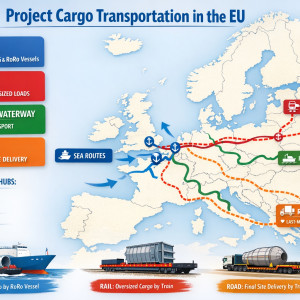
The latest official data on EU freight transport confirms the enduring dominance of maritime and road transport in the movement of oversized, breakbulk, and project cargo across Europe, while rail and inland waterways remain niche but strategically important options. Maritime shipping continues to carry the bulk of Europe's heavy-lift and project cargoes[1], accounting for roughly two-thirds of total freight measured in tonne-kilometres, says Eurostat[2], the EU's official statistics agency. Major ports such as Rotterdam, Antwerp, Hamburg, and Marseille remain pivotal hubs for both RoRo and multipurpose vessels, supporting the movement of wind turbine components, industrial modules, and energy infrastructure equipment.
Declined slightly
The Eurostat analysis shows that while maritime's overall market share has declined slightly over the past decade, its role in handling oversized and breakbulk cargo remains unchallenged.
Once cargo reaches Europe's shores, road transport assumes a central role in inland distribution. Road freight accounts for approximately 25 per cent of total EU freight performance, and it is increasingly relied upon for last-mile delivery and oversized shipments to project sites. Recent Eurostat trends indicate that while overall road freight volumes have plateaued in tonnes, tonne-kilometres are rising, reflecting longer or heavier movements inland.
Heavy transport operators continue to navigate regulatory weight limits and route restrictions, underscoring the specialized nature of oversized cargo delivery.
 Copyright (C) ProMedia Group
Rail freight, representing just 5-6 per cent of total EU tonne-kilometres, remains a specialist option for high-volume or extremely heavy cargo. Germany, Poland, and France dominate rail freight activity, with commodities such as metal ores and industrial modules comprising the bulk of rail-based project cargo. Limitations such as cross-border infrastructure bottlenecks, gauge differences, and clearance constraints continue to restrict rail's broader adoption for oversized cargo, although targeted investments could expand its role in the future.
Multimodal
Inland waterways, while contributing only around 1.5 per cent of EU freight, offer cost-effective transport for very heavy or bulky project cargo along major rivers including the Rhine, Danube, and Scheldt.
Barges are particularly suited for industrial and energy-sector modules, providing a green alternative to road transport where geography allows.

Air freight, by contrast, remains negligible for project cargo due to weight and dimension limitations, reserved mainly for small, high-value components. Overall, the Eurostat data reinforce a multimodal pattern for project cargo: sea transport as the backbone, complemented by road for inland distribution, with rail and waterways used selectively for extremely heavy or bulk items. Operators and shippers planning project cargo movements must continue to leverage Europe's major ports, flexible road networks, and specialized rail or barge corridors to ensure timely and efficient delivery of oversized modules across the continent.
Subscribe to gain access to all news
Already have a subscription? Log in[3].
Choose your subscription
Considering a corporate subscription? Contact us[4] to find out more.
Or
Want to read this article for free?
You can read one free article per month.
Enter your email and we'll send you a free link to access the full article.
No payment required.
References
- ^ heavy-lift and project cargoes (www.projectcargojournal.com)
- ^ says Eurostat (ec.europa.eu)
- ^ Log in (www.projectcargojournal.com)
- ^ Contact us (www.projectcargojournal.com)