Are Solid-State Batteries and In-Wheel Motors Coming for Electric Sports Cars?
For more than a decade, automakers have teased modular skateboard EV platforms as enabling lots of "top hats"--resulting in more exciting, relatively affordable niche vehicles that don't have to be produced in high numbers to be profitable, because they carry the same common components. But if you're a fan of compact, light, and nimble, you know that a new breed of electric sports cars--or anything close to a successor to the original Tesla Roadster[1]--still hasn't arrived. What has come instead is a cohort of heavy, high-powered, brute-force EVs--bonkers-accelerating versions of high-seating-point crossover SUVs or long sedans, or supercars with seven-digit price tags.
Not sports cars. At the Consumer Electronics Show (CES) last week, there were some signs of light--and lightness--at the end of the tunnel, from Finland's Donut Lab[2], which claims breakthroughs in solid-state EV batteries, on top of last year's CES-announced in-wheel motors.
 Bengt Halvorson
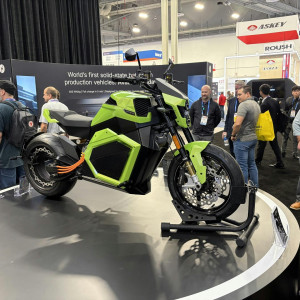
The company showed both an in-wheel motor and solid-state batteries in a Verge TS Pro electric motorcycle, which it claimed was capable of gaining 300 km (186 miles of range) in just 10 minutes via a Tesla-based NACS charge port. More importantly, Donut promised to deliver it in that form within weeks.
"It's in production," said Ian Digman, the business development manager for Donut Lab last week at CES, pointing to the TS Pro. "If you ordered one of those today, that would be delivered in June with solid-state batteries," he said.
 At less than 60 pounds, Donut's 17-inch in-wheel motor could change the game for performance EVs.Bengt Halvorson
If Donut's tech can be delivered in cars, it could resuscitate the dream of EVs that match not just the form factor of a Mazda Miata[3] but the weight of one, without big range compromises. That's where a partnership with UK-based Watt Electric Vehicle Company (WEVC) comes in. The featherweight Longbow Speedster[4], engineered and built with Watt, is an open-top electric sports car that weighs less than 2000 pounds and starts around £110,000 (or £85,000 for the upcoming fixed-roof Roadster).
And at CES, it showed a prototype version with 900 hp from four in-wheel motors weighing as little as 42 pounds each. The Longbow doesn't have solid-state battery tech yet, and using them would shed even more weight.
Are Solid-State Cells Really Here?
 Donut's 5kWh solid-state battery weighs just 30.8 pounds.Bengt Halvorson
 The company's 125Wh unit is a mere 11 ounces.Bengt Halvorson
Solid-state cells, which omit the liquid electrolyte of modern lithium-ion cells (and some of the concerns for fire) have the potential to break the cycle of bulk. But research labs, battery suppliers, startups, and big automakers have been stymied by challenges to ramp up production of cells that meet durability requirements.
Thus, the announcement from CES that privately funded Donut Lab will deliver true (dry) solid-state batteries in a production motorcycle within weeks--and in all 2026 model-year Verge Motorcycles--is a big surprise for the industry. So is Donut Lab's claim that these batteries are cheaper to produce than lithium-ion cells, can hold out over a shockingly long life of 100,000 charge cycles, and will charge in as little as five minutes. The firm also claims the design "eliminates the root causes of battery fires" and offers resistance to extreme temperatures.
For all of Donut's assertions, there has been no third-party verification yet, and it says patents are pending. But if claims prove true, this could signal a long-awaited inflection point for the industry and how it conceives EVs. Donut is ramping up production of 125-Watt-hour cells that weigh just 11 ounces each--amounting to an energy density of 400 Wh/kg.
In module form for automotive purposes, each air-cooled 5-kWh brick weighs just 30.8 pounds. To help underscore what a revelation it could be, you could install the 24-kWh capacity of the original Nissan Leaf with about 150 pounds--a quarter of the original weight. Or you could cut the weight of the 75-kWh pack in earlier Tesla Model 3 and Model Y versions by more than 50%, before even getting rid of their liquid cooling.
Donut Lab started with Verge, but the firm of just 42 employees broke away as a separate company last year with the backing of former Nokia CEO Risto Siilasmaa. As of yet, Donut's battery production is in Finland, but with expanded capacity from Estonia (where the bike itself is made) and the U.K., it claims it will reach a gigawatt-hour of annualized capacity later in 2026. That could leave plenty extra for cars.
Freeing Up Space, Escaping the Weight Spiral
 Watt's PACES platform could make easy niche production a reality.Bengt Halvorson
Alongside Donut Labs at CES, Watt Electric Vehicle Company showed how it can incorporate solid-state cells and in-wheel motors together, while keeping weight down and allowing more space and design freedom with its Passenger And Commercial EV Skateboard.
Abbreviated PACES, it's a completely different approach than that used by automakers' big EV platforms, with their inboard motors and big brick-like battery packs under the floor sometimes contributing to the structure. PACES uses a system of bonded and extruded beams, made of green Norsk Hydro aluminum, which feature a super-thin profile of just 1.8 millimeters--the key not just to the weight savings and tight dimensional tolerances but to keeping costs down. "At the moment our focus is around supporting either existing automakers or new startups with getting products from concept to market, and to reduce the time and reduce the cost," said WEVC founder and CEO Neil Yates.
In addition to the Longbow, Watt is the "production supplier" behind the Can-Am-inspired Nichols N1A[5] mid-engine V-8 sports car; it's working on global programs for next-generation vehicles at various phases of development; and it has a different sports car project (think multiple thousands annually) that will go public this summer, with a July production start. WEVC said that it's having a lot of conversations with big OEMs who are struggling to do anything niche and fun these days, because the business case is really tough. Designers might have brilliant ideas for electric sports cars and niche-vehicle form factors, Yates explained, but once they fit into normal development channels you suddenly need massive production numbers--and then you likely lose the original concept.
 The WEVC Longbow Speedster on display at CES.Bengt Halvorson
Watt's platform is also ready to recalculate the vehicle layout and optimize for in-wheel motors--as featured in the Longbow Speedster.
With them, you do have to account for the extra "unsprung mass" of the motor as added to the wheel, but you don't have driveshafts, a transmission, or differentials, and there's a lot of untapped potential in wheel-by-wheel torque vectoring or essentially using blips of wheel torque to affect suspension behavior. Watt uses a module-to-chassis approach, in which the vehicle chassis is the battery pack, protected from below by a base plate made of multiple laminate layers of composite and aluminum. With the Longbow sports cars and other EVs, it has used liquid-cooled modules of common 2170-format cylindrical cells.
But the solid-state cells need no active cooling in passenger-car applications, Yates said. Donut hinted what at might yet come in its CES press release, noting that the solid-state cells could be made in "non-traditional formats like serving as the body of a drone or a vehicle chassis." Is Donut's technology as game changing as it sounds?
If it proves out, a golden age of electrified sports cars may be upon us.
References
- ^ Tesla Roadster (www.hagerty.com)
- ^ Donut Lab (www.donutlab.com)
- ^ Mazda Miata (www.hagerty.com)
- ^ featherweight Longbow Speedster (www.hagerty.com)
- ^ Can-Am-inspired Nichols N1A (www.hagerty.com)