Roads or rice fields
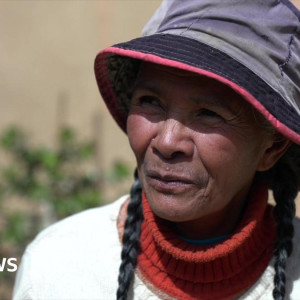

She has supported her family - including a son who cannot work due to living with mental health issues - with farming her whole life.
But now both her pineapple and rice fields lie in the way of the new road.
"It hurts me, I feel like I've been stabbed in the back," she says on a short but steep walk down to her rice paddy.
"It's hard because no-one has been in touch with us about the plan (for the highway). This is the land we have owned for generations. It's heartbreaking."
She also says that no compensation package has been agreed with the government.
This is a claim that farmers repeatedly tell us as we travel around the area, but the authorities have pledged that compensation will be provided within a year of the road being built.
The first 8km (five miles) of the highway was officially opened by then-President Andriy Rajoelina - who commissioned the project - during a southern African regional summit in the country in August.
He was deposed in a coup in October, with the new government saying it will continue with the project.
Built by Egyptian construction company Sancrete, it will eventually stretch for some 260km and will cost around £4 (?2.90) for cars and £5 for lorries to use.
When it comes to funding the estimated £1bn project, a fifth will be coming from the state with the rest from outside sources, such as the Arab Bank for Economic Development in Africa.
The smooth tarmac and clear road markings of this first stretch certainly contrast with the unmarked, frequently potholed roads that make up much of Madagascar's transport network.
If you want to travel between Antananarivo and Toamasina currently, that involves taking what is called Route National 2.
Progress along it can be slow going, as the heavy traffic on the two-lane road squeezes through small towns and navigates around crevices in the road.
Old women filling in potholes with dirt in exchange for tips from drivers can be seen.