Heriot-Watt logistics experts to address sustainable road freight event
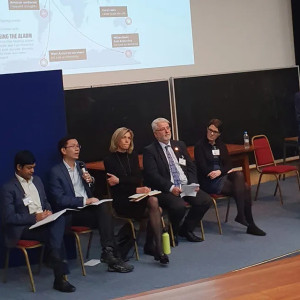
Logistics experts from Heriot-Watt University will discuss barriers and solutions to freight transport decarbonisation at a major event next week on scaling-up electric road freight transport.
The researchers are taking part in the 12th International Workshop on Sustainable Road Freight[1], hosted by the Centre for Sustainable Road Freight[2], which is a collaboration between the University of Cambridge[3], Heriot-Watt University[4] and University of Westminster[5]. The event is sponsored by the UK national research hub, TransiT[6], which is jointly led by Heriot-Watt University and the University of Glasgow and is focused on rapidly decarbonising transport using digital twins, digital replicas of the real world.
Hosted in Cambridge and online on Monday 8 and Tuesday 9 December, the event will discuss efforts required from governments, freight users, operators and other stakeholders to create sustainable and scalable solutions for electrifying road freight transport networks globally.

Professor Phil Greening, Deputy Director of the Centre of Sustainable Road Freight and Programme Lead for TransiT, will deliver the opening keynote speech on day one of the event.
He said: "Electrification is the key to decarbonising road freight. But it brings multiple challenges.
There are uncertainties about electric vehicles and their capacity, about the availability of charging infrastructure, about the changing policy landscape. And of course about cost - and who's going to pay for it all.
"Our role as scientists is to help remove some of this uncertainty - through research and evidence that gives logistics operators and stakeholders the confidence to start investing in electric fleets and infrastructure."
More than 30 research papers will be presented at the 12th International Workshop on Sustainable Road Freight.

Researchers from Heriot-Watt University speaking at the event include Dr Sandy Hassan[7], an Assistant Professor of Logistics and Supply Chain Management at Heriot-Watt's Edinburgh Business School[8] and a researcher for TransiT.
In a session on decarbonisation challenges and transition pathways, Dr Hassan will highlight the need for different transport modes - including road, rail and shipping - to work together to explore decarbonisation solutions - rather than just focusing on their own sectors and operations.
"These sectors each have their own unique decarbonisation challenges," Dr Hassan explains. "But they are also all interdependent. And this can have complex consequences that unfold over time and may actually deter full decarbonisation efforts.
Our research is exploring the interdependencies between ports, road, rail and maritime transport, and the need for joint action across the whole transport system."

Aseem Kinra[9], a global supply chain management expert and Professor at Heriot-Watt University's iNetZ+ Global Research Institute[10] for net zero and beyond and its School of Energy, Geoscience, Infrastructure and Society[11] will present at the event as part of a session on special cases and applications for electric heavy goods vehicles (eHGVs).
Professor Kinra's research explores challenges and solutions around bringing electric charging infrastructure to remote ports.
"While large ports have benefitted from green investment, smaller and remote harbours lack the resources and capacity to plan for electrification, and each will have its own unique characteristics and decisional challenges in their route towards electrification" he explains. "Without targeted support, these harbours risk being left behind, with negative consequences for regional economies and coastal communities."
The research outlines a seven-step Systems Transition Engineering Process (STEPs) approach that helps to identify the paradoxes in port electrification. This can break the decisional deadlock and unlock the investment needed to transition the freight system, by helping decision-makers better understand electricity supply and demand factors.

Two Heriot-Watt researchers, Aghdas Badiee[12] and Alan Logan[13], will present research on freight decarbonisation solutions for Scotland.
Dr Badiee, a Post-Doctoral Research Associate at the Centre for Sustainable Road Freight, will discuss how to develop and implement sustainable transport for perishable food logistics in Scotland, with a special focus on beef supply chains.
She said: "This project tackles crucial cold chain logistics challenges with refrigeration systems and alternative energy solutions, combined with digitalisation to reduce emissions while maintaining food security."
Dr Logan is a data scientist, TransiT researcher and Assistant Professor in the Centre for Sustainable Road Freight, with a focus on how to use data to accelerate the decarbonisation of the haulage sector.
In a session on Charging Infrastructure for eHGVs, Dr Logan will present his team's work on mapping Scotland's future charging infrastructure for electric trucks.
He said: "Our project identifies critical locations for charging and refuelling infrastructure in Scotland, which can be used by policymakers and industry stakeholders to prioritise and phase the development of these facilities."

Also presenting at the 12th International Workshop on Sustainable Road Freight is Dr Asrul Ismail[14], a TransiT researcher and Research Associate at Heriot-Watt University, specialising in operations research and artificial intelligence, with a focus on supply chain management and future transport systems.
Dr Ismail will present research on how to optimise last mile delivery logistics from multiple depots in the Midlands region, by comparing traditional internal combustion engine vans with electric vehicle alternatives.
He explains: "The primary goal is to evaluate the feasibility, efficiency, and sustainability of integrating or switching to electric vehicles within existing logistics operations, while considering the challenges associated with routing, energy consumption, infrastructure limitations and emissions."

The Centre for Sustainable Road Freight brings together multi-disciplinary teams of researchers and industry leaders to improve road freight efficiency and reduce its environmental impact.
Professor David Cebon, Director of the Centre for Sustainable Road Freight and a Professor of Mechanical Engineering at Cambridge University, said: "Scaling-up the electrification of road freight transport presents several key challenges. One major issue is the need for robust charging infrastructure, especially in regions with limited access to high-capacity charging stations.
"Battery technology is another critical concern.
While progress is being made, current batteries still have limitations in terms of range and weight.
The high upfront cost of electric trucks can also make them prohibitively expensive for many businesses, particularly small and medium-sized enterprises.
"And the regulatory landscape is fragmented across different countries and regions, creating a complex patchwork of rules, incentives and standards."
For more event information and registration details, visit the 12th International Workshop on Sustainable Road Freight web page[15].
TransiT is a collaboration of eight universities and almost 70 industry partners, jointly led by Heriot-Watt University in Edinburgh and the University of Glasgow and funded by the UK Research and Innovation Engineering and Physical Sciences Research Council the main funding body for engineering and physical sciences research in the UK.
Digital twins are digital replicas of the physical world that allow decarbonisation scenarios to be identified and tested much faster and more affordably than in real world trials.
References
- ^ 12th International Workshop on Sustainable Road Freight (www.csrf.ac.uk)
- ^ Centre for Sustainable Road Freight (www.csrf.ac.uk)
- ^ University of Cambridge (www.cam.ac.uk)
- ^ Heriot-Watt University (www.hw.ac.uk)
- ^ University of Westminster (www.westminster.ac.uk)
- ^ TransiT (transit.ac.uk)
- ^ Dr Sandy Hassan (www.hw.ac.uk)
- ^ Edinburgh Business School (www.hw.ac.uk)
- ^ Aseem Kinra (researchportal.hw.ac.uk)
- ^ iNetZ+ Global Research Institute (www.hw.ac.uk)
- ^ School of Energy, Geoscience, Infrastructure and Society (www.hw.ac.uk)
- ^ Aghdas Badiee (www.csrf.ac.uk)
- ^ Alan Logan (transit.ac.uk)
- ^ Dr Asrul Ismail (transit.ac.uk)
- ^ 12th International Workshop on Sustainable Road Freight web page (www.csrf.ac.uk)