Honda ZR-V first drive | premium feel for new hybrid crossover
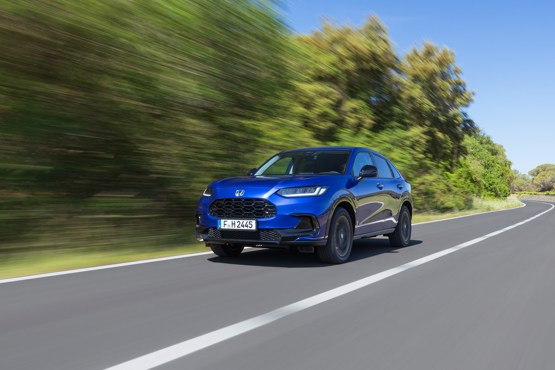
Honda is targeting drivers who aren’t ready for electric vehicles with its new ZR-V C-segment SUV, which goes on sale in July.
Set to slot between Honda’s existing SUVs, the large and spacious CR-V and the more compact HR-V, the ZR-V is positioned as a more premium alternative to the Nissan Qashqai[1].
It is packed with Honda’s usual build quality, desirable tech and no-nonsense attributes. This is reflected in its pricing, which starts at £39,495. For comparison, a Qashqai e-Power Hybrid starts at £34,210.
The ZR-V is the newest model to come with to Honda’s clever 2.0-litre e:HEV hybrid powertrain. First introduced in the Civic, this new powertrain offers a reduction in CO2 emissions from a standard petrol unit, but the ZR-V still emits from 130g/km and therefore sits in the 31% benefit-in-kind tax band. Drivers should expect monthly bills of around £200.
Set upon a modified Honda platform combining the best bits of the Civic and CR-V, the Honda ZR-V is front-wheel drive. Unlike in some nations where petrol powertrains are in the range, in the UK ZR-V will only be offered with a pure hybrid line-up when first deliveries come through in autumn 2023.
The car’s petrol engine works in conjunction with two electric motors to provide good levels of performance – acceleration from 0-62mph takes just 7.8 seconds. Maximum power of 183PS is achieved, with 315Nm of torque.
There is no traditional gearbox in the Honda ZR-V and the system instead phases drive from the electric motor to replicate gearchanges; around town, it’s mostly silent as the engine spins a generator to make power for the electric motors; accelerate hard down a motorway slip road or twisty back road and the engine clutches onto the wheels. Cleverly in this instance the e-CVT transmission is tuned to rise and fall to sound like a conventional ICE car, so the Honda ZR-V avoids the noise of soaring revs that have blighted most full hybrids since they first arrived with elastically geared CVT gearboxes a quarter of a century ago.
At 1,620mm tall unladen, 1,840mm wide and 4,568mm long, with a 2,657mm wheelbase, the ZR-V slots neatly into the current Honda SUV line up. Being wider than the HR-V, the car feels pretty spacious in the front – no risk of knocking elbows. This is a five-seater with ample space for four adult passengers, five at a push, and a modest 380-litre boot.
The interior is finished to a high standard and provides physical switchgear for key functions, rather than bundling them all in to the touchscreen.
Honda UK is deliberately keeping the decision-making simple for customers. There are three trim levels on offer: Elegance, Sport and Advance.
Elegance’s highlights include keyless entry and ignition, heated front seats, rear parking camera, auto lights and wipers, dual climate control standard on all models.
Sport adds half-leather seats, power tailgate, privacy glass, wireless phone charger and slightly sportier body styling.
Advance comes with full leather upholstery, a panoramic opening sunroof, electric seats, heated steering wheel, head-up display, heated rear seats and adaptive headlights.
The ZR-V is the latest Honda car to feature the company’s advanced suite of Honda SENSING technologies as standard. Combined with a comprehensive airbag system and impressive all-round collision performance, the ZR-V achieves high levels of both active and passive safety.
The Honda ZR-V is super-relaxing to drive. The e:HEV powertrain is whispery quiet most of the time and this calm ambience is matched by a quiet, well-judged ride. This car is certainly a welcome addition to Honda’s line-up.
References
- ^ Nissan Qashqai (www.fleetnews.co.uk)